
star power
Making the case for residential solar on Bainbridge Island
Words by Alorie Gilbert

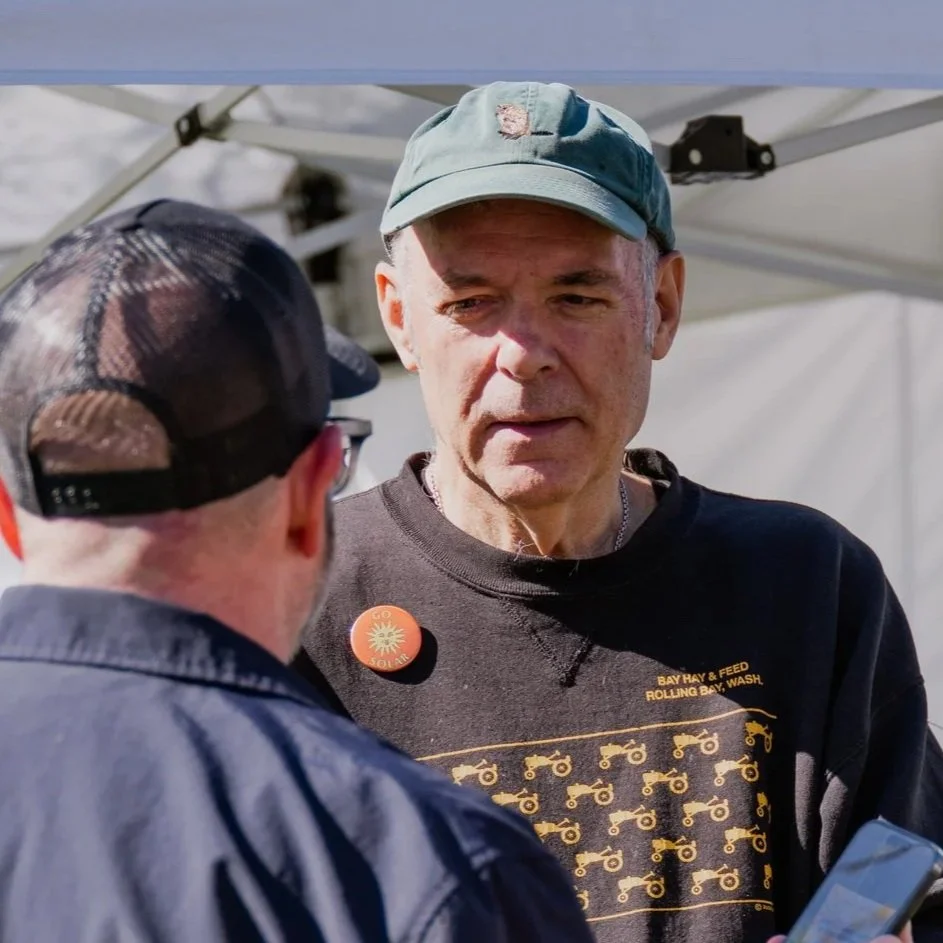
Corbin DeRubertis switched to solar energy and electric vehicles three years ago and has never looked back (Photo: Olya Blase)
Imagine paying for electricity just a couple of months out of the year and never sweating power outages or price hikes at the gas pump. For Bainbridge Island homeowner Corbin DeRubertis, who switched to solar energy and electric vehicles three years ago, it's a pretty good feeling, especially with electricity and fuel prices soaring this year.
Although it took a hefty personal investment in panels, batteries and vehicles, DeRubertis has never looked back. "The liberation of not having to go to the pump anymore is one thing, but having most of that (energy) off solar is doubly rewarding," he reports.
DeRubertis represents a slim minority of homeowners on Bainbridge Island. Only five percent of island homes and buildings generate their own solar power, accounting for just two percent of the island's energy usage. But new efforts by the City of Bainbridge and local nonprofits aim to increase that figure, despite the rollback this year of federal tax incentives. "We call it the solar coaster," said Ben Silesky, program director at Olympia Community Solar. "Every year, the policy landscape for solar changes so dramatically, but there is still an overarching trend of adoption."
Olympia Community Solar, based in Olympia, Wash., has partnered with the City of Bainbridge this year to launch Solarize Bainbridge. The program helps homeowners assess the costs and benefits of switching to solar energy, vets installers and offers group purchasing discounts on panels and related equipment. The campaign kicked off in March, offering a series of free workshops and home assessments for homeowners and business owners who sign up by July 31.
Solar Collective volunteer Joe Deets (Photo: Olya Blase)
Also launching this year is the Bainbridge Solar Collective, a program focused on accelerating residential solar installations. The group aims to be a repository of local best practices, offering tours of installations, newsletters and permitting assistance. It's led by islanders Mike Cox, Kevin Thomas and Fran Korten, working under the nonprofit Sustainable Bainbridge. The group is working in tandem with Olympia Community Solar, which has sponsored Solarize programs across the Puget Sound, helping more than 400 homeowners transition to solar energy since 2021. "We're trying to demystify the process and give people the confidence to look into this option in a serious way, knowing that there are a lot of factors outside of their control," Silesky says.
Those factors include the orientation and condition of your roof, how shaded by trees or other buildings it is and, of course, the weather. Even with all our rainy, overcast days, residential solar can still pencil out financially in Washington, thanks in part to net metering. That program, offered by Puget Sound Energy, lets homeowners bank energy credit in sunnier months, when solar systems generate enough surplus electricity to feed the utility grid.
Even with net metering and solar home batteries, DeRubertis and most homeowners in the Pacific Northwest aren't able to eliminate utility bills entirely. "In the winter, don't think you're not going to have an electric bill," said DeRubertis. "That's the first thing I always tell people, you're not going off-grid, you are significantly offsetting your usage."
That means Washington homeowners can expect a longer payoff period compared to their counterparts in sunnier states. Breaking even on a typical $25,000-plus system can take 10 to 15 years, according to Silesky. DeRubertis expects to break even on his investment in just six years, accounting for fuel savings from his two electric vehicles.
"You have to be thoughtful about it and really think about what you want out of it," DeRubertis cautions. "It's an investment for sure. You're investing in your peace of mind or your desire for a more sustainable living option where your dependence on outside systems is reduced."
Silesky framed it this way at a Solarize workshop in March: by adopting solar, households effectively pay now for the power they will consume over the next 25 years, buffering themselves from ever-rising energy rates and market volatility. "Plus, let's talk about how frickin' cool solar is," he said. "For all of human history, we've gotten our energy primarily by burning stuff, but now we have the opportunity to get it directly from the source, the giant thermonuclear star in the sky."
Model your home energy demand
Local solar momentum isn't just about rooftops. Local resident and entrepreneur Corbin deRubertis has built a free online tool called Gridzo that takes the guesswork out of big questions for anyone considering solar: How much energy do I actually use? And how could solar change the mix in my home?The tool builds a personalized energy demand model based on your address and how you answer questions about your heating, cooling, hot water, appliances and vehicles, including EVs. The result is a clear picture of your actual needs before you ever talk to an installer.
Solar power myths, debunked
MYTH: Solar doesn't work in Washington, it's too cloudy.
FACT: While direct sunlight is the most efficient, solar panels work even on overcast days. Plus, Washington has long, sunny, temperate days late spring through early fall. The credits you receive from your utility during these months can significantly reduce your energy bill for the year.
MYTH: Solar is too expensive and will never pay for itself.
FACT: The solar payback period is typically between 10 to 14 years, depending on the system and solar exposure. Solar can feel like an expensive investment upfront, but it often pays for itself about three times over during its 25-year warranty lifespan. Most solar systems will be less than the cost of a new car and unlike a car, its value only increases over time.
MYTH: Solar hurts the grid.
FACT: Solar is a key resiliency asset for grid operators. The most affordable and reliable grids have a mix of different energy sources that provide flexibility and redundancy. When low temperatures freeze infrastructure or storms interrupt fuel supplies, solar has shined as a resilient option, even in challenging conditions.
MYTH: Solar panels and batteries are made overseas.
FACT: Today, the U.S. makes enough solar panels to supply 100 percent of domestic demand, a sixfold increase from just a few years ago. The panel components and batteries are increasingly made here, in factories from the Carolinas to California, providing thousands of Americans with well-paying jobs.
MYTH: Solar panels damage your roof and require high maintenance.
FACT: When properly installed, roof panels act as a protective shield from weather elements. With no moving parts, solar panels require very little maintenance, just occasional cleaning to remove dirt or snow.
Provided by
Bainbridge Solar Collective