
a walk in the woods
How the Great Peninsula Conservancy is transforming timberland back into healthy forests across the West Sound region
Words by Kathryn Arnold
Photo: Bartfett/iStock
At first sight, The Divide Community Forest in the heart of North Kitsap doesn't look like my idea of a Pacific Northwest forest. It lacks towering, moss-clad trees, plumes of sword ferns, mounds of berry-laden salal or evidence of animal activity. What I see is a plantation of overcrowded, spindly, 10- to 12-foot-tall Douglas fir saplings struggling to reach their crowns above a fortress of non-native Scotch broom.
One doesn't need a degree in ecology or forestry to recognize that this landscape has been degraded by clear-cut logging and replanted with a monocrop of Douglas fir trees intended for the sawmill. But The Divide's current state didn't deter Bremerton-based Great Peninsula Conservancy (GPC) from purchasing the 467-acre timber stand in 2025. Their intention was to restore it to a healthy forest, one that welcomes wildlife and provides a range of ecosystem services, from water filtration to carbon sequestration.
I've come here on an unusually warm day in early December to meet Adrian Wolf, GPC's stewardship director, and Samantha Hale, communications director. I wanted to find out why the organization bought this broken forest and how they plan to fix it.
GPC purchased The Divide with the help of a USDA Community Forest Program grant, which stipulates that The Divide must be managed for the ecological, recreational and economic benefit of the local community. To fulfill that promise, GPC convened a Community Forest Advisory Team (CFAT) made up of state and county government agencies, environmental non-profits, community members, foresters and tribal members. "They will work together over the next couple of years to determine what is going to happen with this land and GPC will guide that process. As a community forest, our management of The Divide is different from our other preserves. We have an obligation to generate some sort of economic revenue," says Hale. CFAT and GPC could interpret how that's done in a number of ways, from selective timber harvesting and brush picking for wreaths to carbon credits, for example.
The Divide is a significant acquisition for GPC because it adjoins another of their projects, the 282-acre Grovers Creek Preserve, and supplies the missing link for completing the Kitsap Forest & Bay Project, Hale explains. The Kitsap Forest & Bay Project, envisioned as a 5,000-acre wildlife corridor and recreational trails system stretching from the Hood Canal to Puget Sound's Central Basin, required 30 community groups collaborating over 20 years to manifest. With The Divide in place, the effort is a giant step closer to becoming reality.
The Divide is worth conserving, Wolf says, because it straddles two watersheds and encompasses a variety of ecosystems, including 26 acres of wetlands. In other words, it has a lot of potential for recovery. "It looks much worse from the road edges where we're standing because that's where the Scotch broom is most prolific, but when you step into the interior, things don't look quite so bad. It's not homogeneous by any means. There are unique wetland complexes out there, and there's a unique assemblage of species associated with those," he says.
There are more than 25 bodies of water (some as large as four-and-a-half acres) spread across the property. And there's a surprising amount of plant diversity concealed by all that Scotch broom. A botanical survey of the property found more than 140 native plant species, from trees and shrubs to forbs and grasses—big leaf maple, flowering red currant, salmonberry and fringe cups, to name just a few.
GPC enlisted Northwest Natural Resource Group, Haven Ecology and Research LLC, and the Port Gamble S'Klallam Tribe to develop the Forest Management Plan for The Divide. Haven also wrote the Invasive Species Management Plan. These blueprints provide prescriptions for restoring a native forest structure and species diversity while also boosting resistance to climate change. They are grounded in the principles of ecological forestry, a relatively new approach to forest stewardship that looks at a forest as a whole living system, rather than a source of single-crop trees.
Ecologists use the word "seral" to refer to life stages of a forest, Wolf explains. "So what we're working toward is moving from an early seral stand toward the late seral conditions of an older stand," he says. The property's former late seral forest would have had a heterogenous, multi-layered canopy and understory, large-diameter conifers draped in lichens, abundant snags (dead standing trees), and lots of coarse, woody debris (downed trees and large branches).
Initial efforts to nudge The Divide toward a late seral state will focus on replanting different kinds of hardwood and evergreen trees in areas where the Douglas firs have failed and in the wetland ecosystems. "Diversity begets diversity. If you diversify a stand, you're going to see a response in all these other trophic levels (across the food web), from invertebrates and amphibians to birds and small mammals," Wolf says. They'll use a phased approach to reduce the Scotch broom by mechanical and manual means. And in another 15-20 years, they will selectively thin Douglas fir trees. I cringe when Wolf mentions the "T" word, but he says thinning is necessary to reduce competition between the Douglas firs, make space for the planted species to flourish and to promote regeneration of native plants.
To show me how thinning and other ecological forestry strategies can enhance forest recovery, Hale and Wolf guide me to the northwest corner of Grovers Creek Preserve to see a stand of Douglas fir trees that are 35-40 years old and more than 60 feet tall. Hale points to one and says, "Look up at this tree. The live crown is just at the top. Everything below that isn't photosynthesizing, not sustaining the tree. You might think that because the tree is so tall, it's healthy, but really that tree's not doing great."
The average number of trees per acre in a late seral forest is 50; here, Douglas-fir trees numbered 350 per acre before GPC removed about half of them in 2022.
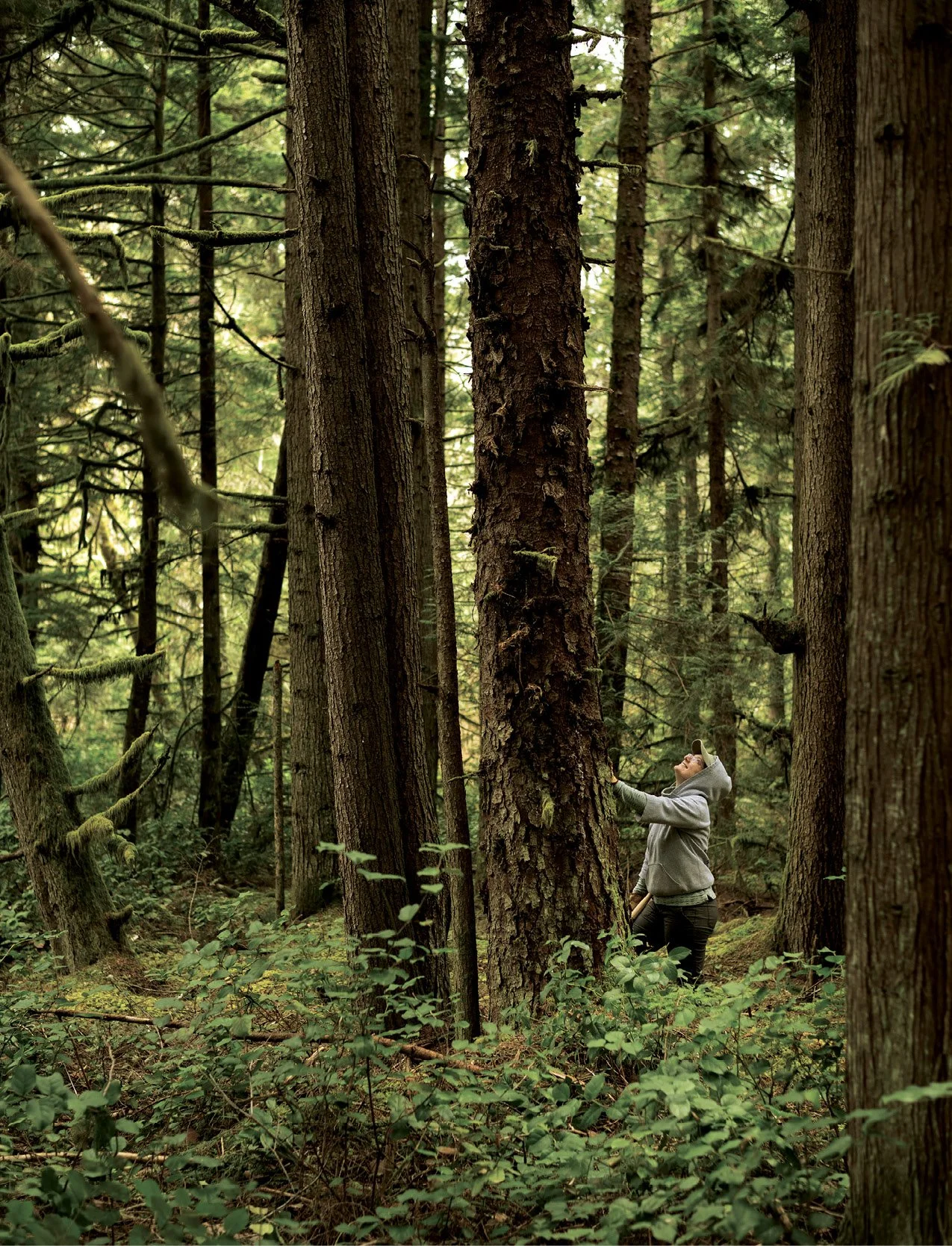
Stewardship Manager Micaela Petrini admires a Sitka spruce in the heart of GPC's Grovers Creek Preserve. (Photo: Ben Wymer)
"Before this stand was thinned, this was a biological desert," says Wolf. "The tree canopies blocked sunlight from reaching the forest floor. Not even salal was growing below." After thinning, there's more space between the trees so they receive light to all parts of their canopies, and sunlight filters to the ground, reinitiating the understory. With fewer competitors, the remaining trees receive more moisture and nutrients than before, increasing the likelihood that each will have enough water to survive changing environmental conditions.
Whereas conventional forestry regards dead wood as hazardous and prioritizes its removal, ecological forestry views coarse woody debris and snags as essential components of a healthy forest because as they decay, they become reservoirs of nutrients and provide shelter to numerous wildlife species. To replicate the large woody debris found in older forests, GPC left some of the thinned trees where they fell to become constructed logs.
"A constructed log mimics a big tree that's fallen down in an old forest. As it rots out, it's gonna be infested by insects, which provide food for animals that feed upon them," Wolf explains. GPC used other material from the thinning to create wildlife habitat piles—ten-feet-square by six-feet-high stacks of logs and tree branches of varying sizes that simulate the root buttress of a large, fallen tree. GPC girdled a number of standing live trees, a process that involves removing a band of bark from a tree to stop the transport of water and nutrients. Over time, these trees will die and become snags, providing refuge for many wildlife species. Ironically, Wolf says, "There is more life in a dead tree than a living one."
Biological surveys conducted by the USDA Forest Service in Western Washington found that 39 bird and 23 mammal species depend on snags for nesting, roosting, sheltering, denning and feeding.
Signs already indicate GPC's efforts to transform this Douglas fir stand are yielding results. As Hale, Wolf and I wander among the trees, stepping over constructed logs, they identify emerging evergreen huckleberry, salal, Oregon grape, and sword fern. On the northern edge, moss has begun to carpet the forest floor. We even spot bear scat.
"We run plots where we're collecting data on the number of species in an area, the size of the trees, and the density, and we can see differences in how big the trees are now compared to when we started work," Wolf says.
Wolf is most excited about a monitoring tool called an AudioMoth that records bird song. He and his team tie these inconspicuous devices to trees throughout Grover's Creek during bird-breeding season, then set them to record for a couple of hours each morning when birds are most active. Listening to the soundtracks tells Wolf whether birds are responding to the changes he and his team have made in the forest. They've already detected Swainson's Thrush, a species that likes dense understory. Its presence validates Wolf's belief that if you build it, they will come.
Converting former timberlands into thriving forests is an enormous undertaking, so for tasks requiring big equipment to remove trees, GPC hires a contractor, or, as in the winter of 2025, they enlist the Washington Conservation Corps. That year, GPC hired them to plant 3,950 trees in Grovers Creek. But staff and volunteers carry out much of the work. So two months after my meetup with Hale and Wolf, I returned to Grovers Creek with my husband to participate in a tree-planting work party.
Forty community members, from teenagers to seniors, showed up on that sunny winter morning with shovels in hand. GPC's Stewardship Manager, Micaela Petrini, explained that the white pine and grand fir saplings we're about to put in the ground were grown in a Washington nursery from seeds that came from Oregon. The idea behind importing southern genotypes of native trees here, a strategy known as "assisted migration," is that they will better withstand the warmer, drier summers ahead.
Whether this tactic will work is uncertain. Petrini says, "In terms of climate change, we can only hope we're setting these systems up to respond in the best way, but we can't know for sure what's going to happen. Every action we take, nature is either going to like it or it's not. Nature is going to figure it out, just as it has for the longest time. That's why I'm here, to help in the ways that science and best practices identify and then hope we've made the right decisions."
When my husband and I finished planting our allotment of saplings, we struck up a conversation with Sophy and Timothy Johnston, a mother and son duo from Indianola. Timothy, a junior at Kingston High School, tells me the reason he's out here today is to help bring this forest back to health.
"In biology and ecology class there's always talk about climate change and the need to do something about it. But then nothing ever happens. So I think it's really important to understand the impact we have and to take action," he says.
Standing here at the intersection of Grovers Creek and The Divide, I can only imagine what these forests will look like in the future. It will be another 30 years before this Douglas fir stand will begin to function as a healthy forest. For The Divide, it will be at least 50. These are timelines that stretch well beyond most of our lives—certainly beyond mine. What GPC and its volunteers are doing here is an act of faith: planting for a future they won't see, trusting that the work is worth doing anyway.
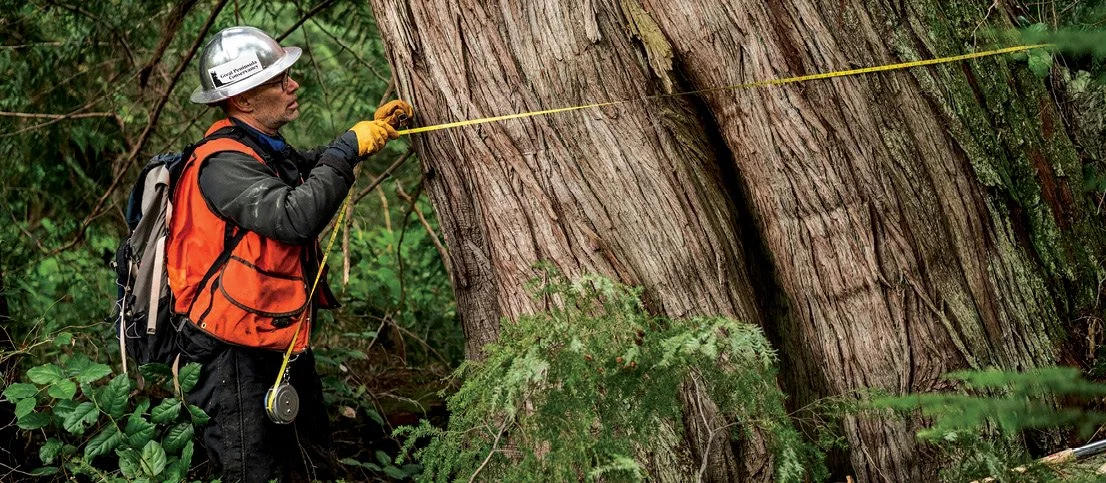
Adrian Wolf measures a Western red cedar in The Divide Community Forest. (Photo: Ben Wymer)
Discover Community Forests
Walk & Talk at Uleland Tree FarmBremerton
Hike to Dickerson Falls to learn about GPC's newest community forest
June 20, 10am - 12pm
Weed Removal at The Divide Community Forest
North Poulsbo
June 27, 10am - 12:30pm
Register:
greatpeninsula.org/event-calendar