
a rising tide
Bainbridge Island Rowing celebrates 25 years of community and athletics
Words by Charlotte Austin
Photos by Andrew Block
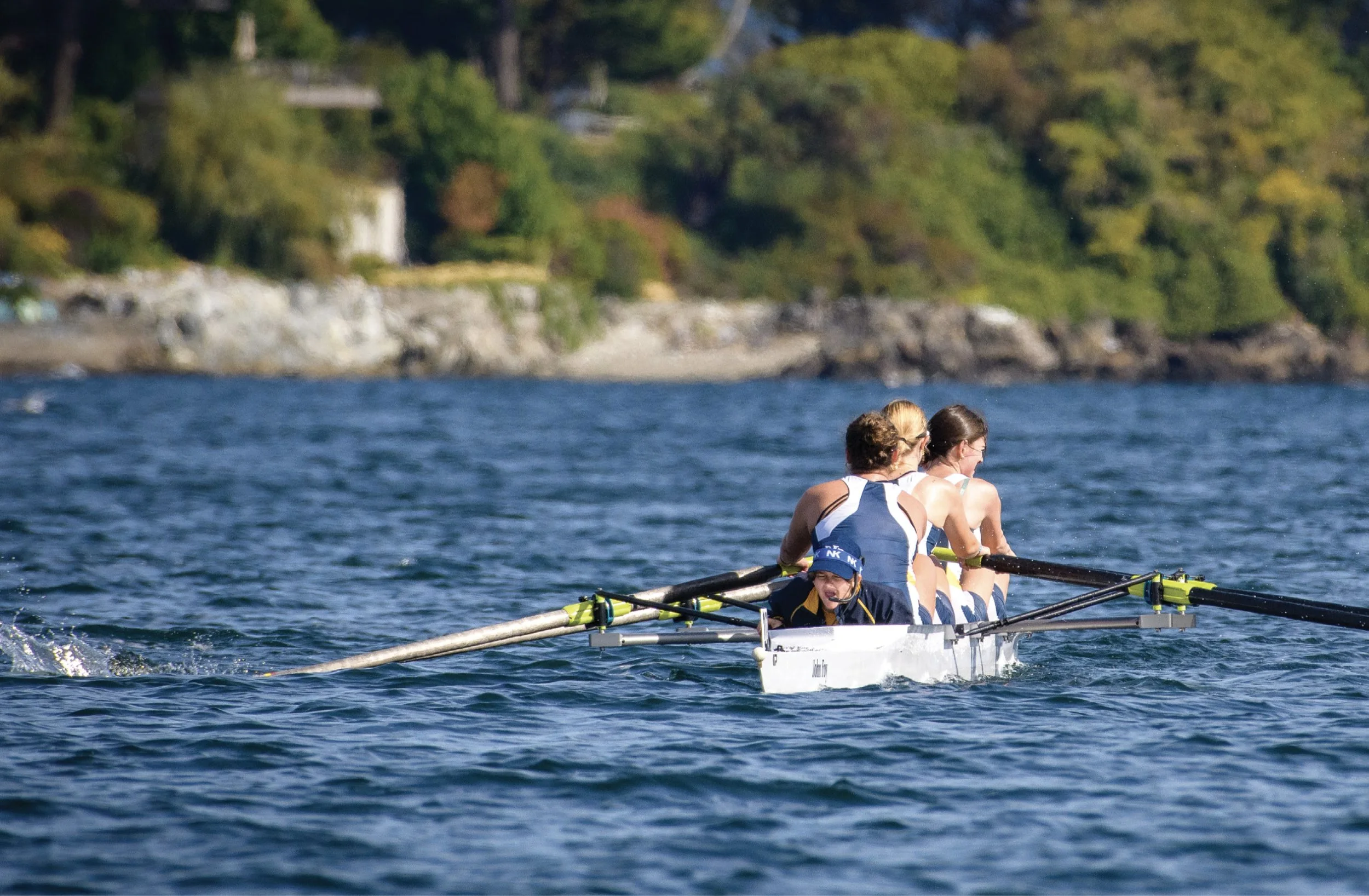
Riding the ferry at dawn, you may have caught glimpses of them: lean silhouettes in whisper-thin shells, their breath wafting in clouds as oars cut through the glassy water. Or you may have walked past them at a local coffee shop: a gaggle of ruddy-cheeked athletes in waterproof shoes and high-visibility clothing, happily chatting as they debrief their row and refuel. You’ll almost never see them out late at night, though. They’re in bed early, rising before dawn to glide across that silky saltwater, watch the sun rise over the ink-purple peaks of the Olympic Mountains and chase that intoxicating flow. They’re the rowers of Bainbridge Island.
The sport of rowing has a long history in the Pacific Northwest—a deeply fertile area for rowers, boatmakers and collegiate teams (just read Daniel James Brown's Boys In The Boat). Organized rowing on Bainbridge Island started decades ago, when a group of intrepid athletes began launching rowing shells off of Pleasant Beach. Eventually, in search of calmer water and a better home base, they moved to an abandoned tennis court in Winslow. Lacking a storage structure, they stacked boats in outdoor racks between practices on Eagle Harbor. Momentum built, and Bainbridge Island Rowing (BIR) was formed.
This year, the organization officially celebrates its 25th anniversary and all its growth over the decades. There's a beautiful boathouse where the tennis court once rested, with gleaming wood floors, an event space and bays stuffed full of sleek racing shells and long carbon-fiber oars. There are dozens of practices each week, with rowers launching boats several times a day. There are community celebrations and collaborations with other local organizations.
Kurt Frost, lifelong resident of Bainbridge Island, has watched the rowing community develop here for more than 50 years. "I grew up in the 1970s with a cedar single (rowing shell) that I would row from our house on Arrow Point out toward Keyport," says Frost. "I did so alone, without a coach, without safety gear."
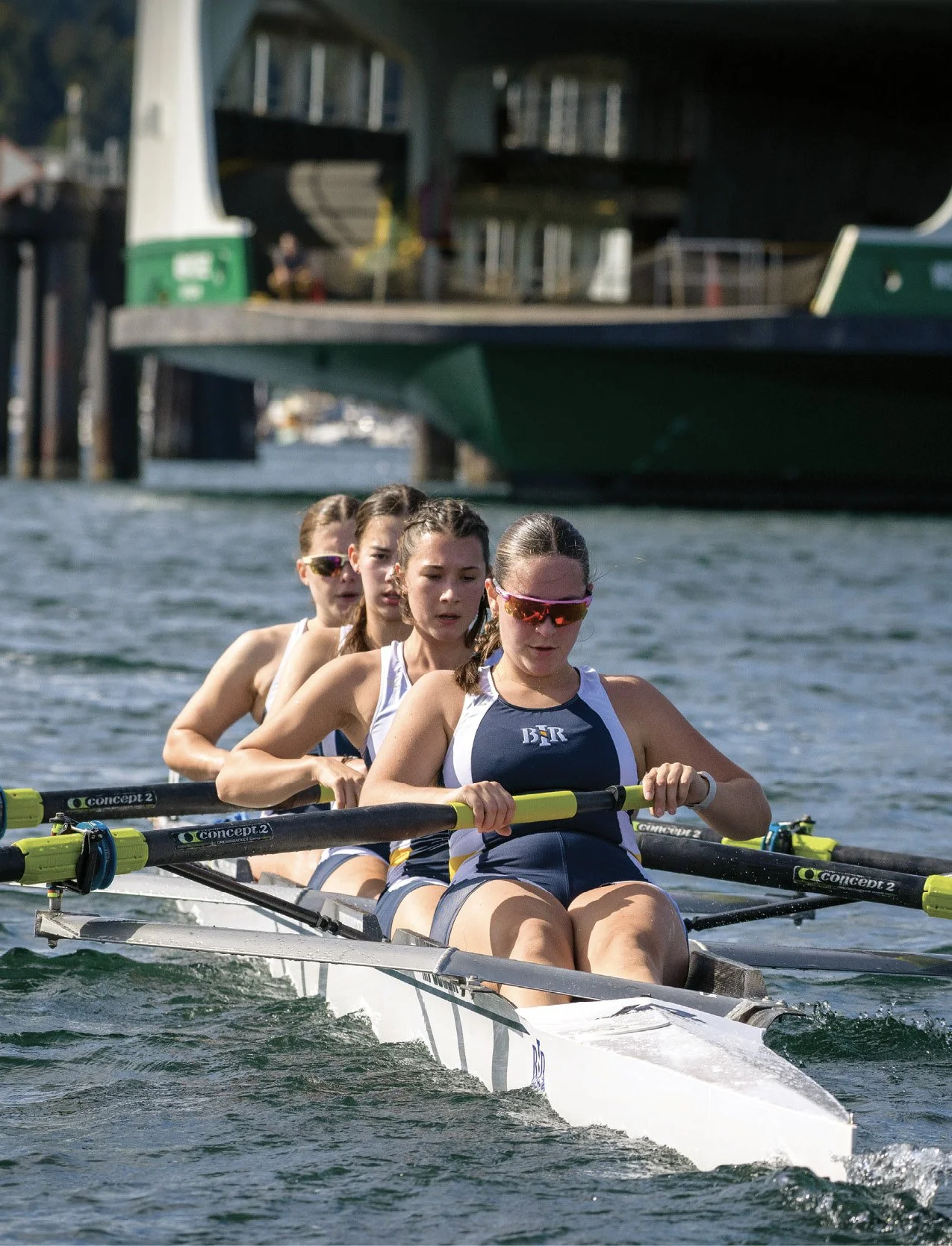
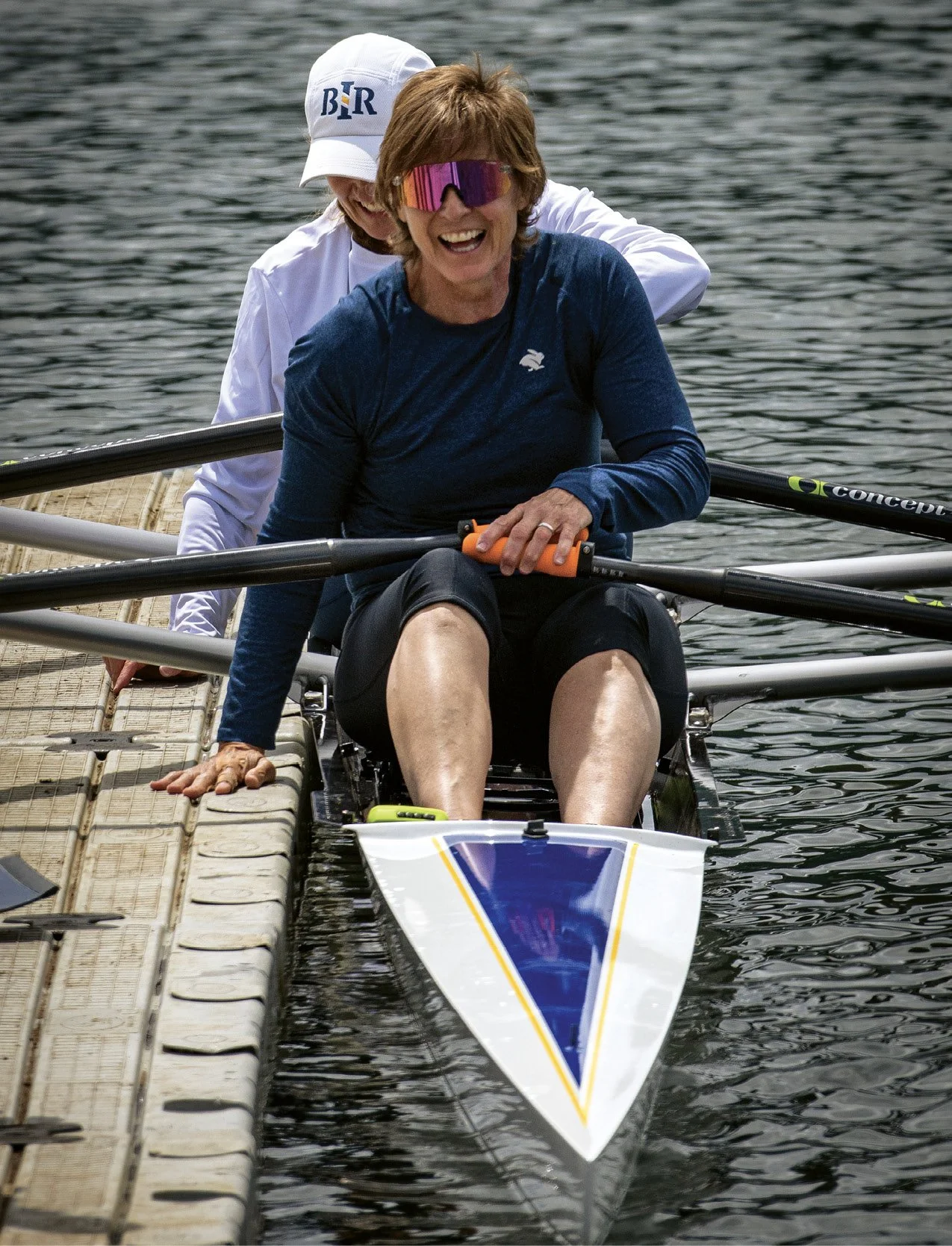
"Now, half a century on, we have a wonderful rowing organization with knowledgeable coaches, a beautiful facility, solid equipment and great camaraderie," he continues. "We've gotten there because of the hard work, dedication, generosity and
vision of hundreds of rowers who came before us."
Today the club strives to serve rowers of all means and ages from across the Kitsap region. Some rowers row for fitness and social connection, enjoying the boathouse as a kind of "third space" between work and home. Others are racing competitively
in regattas around the Pacific Northwest.
In April, the club sent rowers to a regatta hosted by the
University of Washington, aptly named the Husky Open, where Lynn Christiansen, Mia Rogers, Tammy Galbraith and Amanda Pekasky took second place in a field of 14 boats. In October of 2025, Christiansen and her doubles partner, Meg McKinney, took fifth at the ultra-classic Head of the Charles race in Boston, Massachusetts.
Rowing is the most popular sport for high school students on Bainbridge Island, and participation among middle schoolers is on the rise. BIR welcomed 37 middle school rowers this spring, its largest cohort to date. Students don't need previous rowing experience, and nobody is cut from the team. Scholarships are available to students who need financial assistance.
Andrew Ellison, a high school senior who commutes to the boathouse for practice from his home in Kingston, joined the rowing team as a freshman in 2021. "Rowing has taught me a lot, but I especially think it's shown me the true importance of reliability," Ellison reflects. "If I'm not showing up for every practice, the boats can't go out, and my teammates wouldn't depend on me. That's a value I'll carry forward."
While reflecting on its past, BIR continues planning for its next chapter. Amanda Pekasky, director of programs and business development, is implementing new programs, including corporate team-building options, new community offerings and events to celebrate the club's quarter-century anniversary, including an alumni row on July 5.
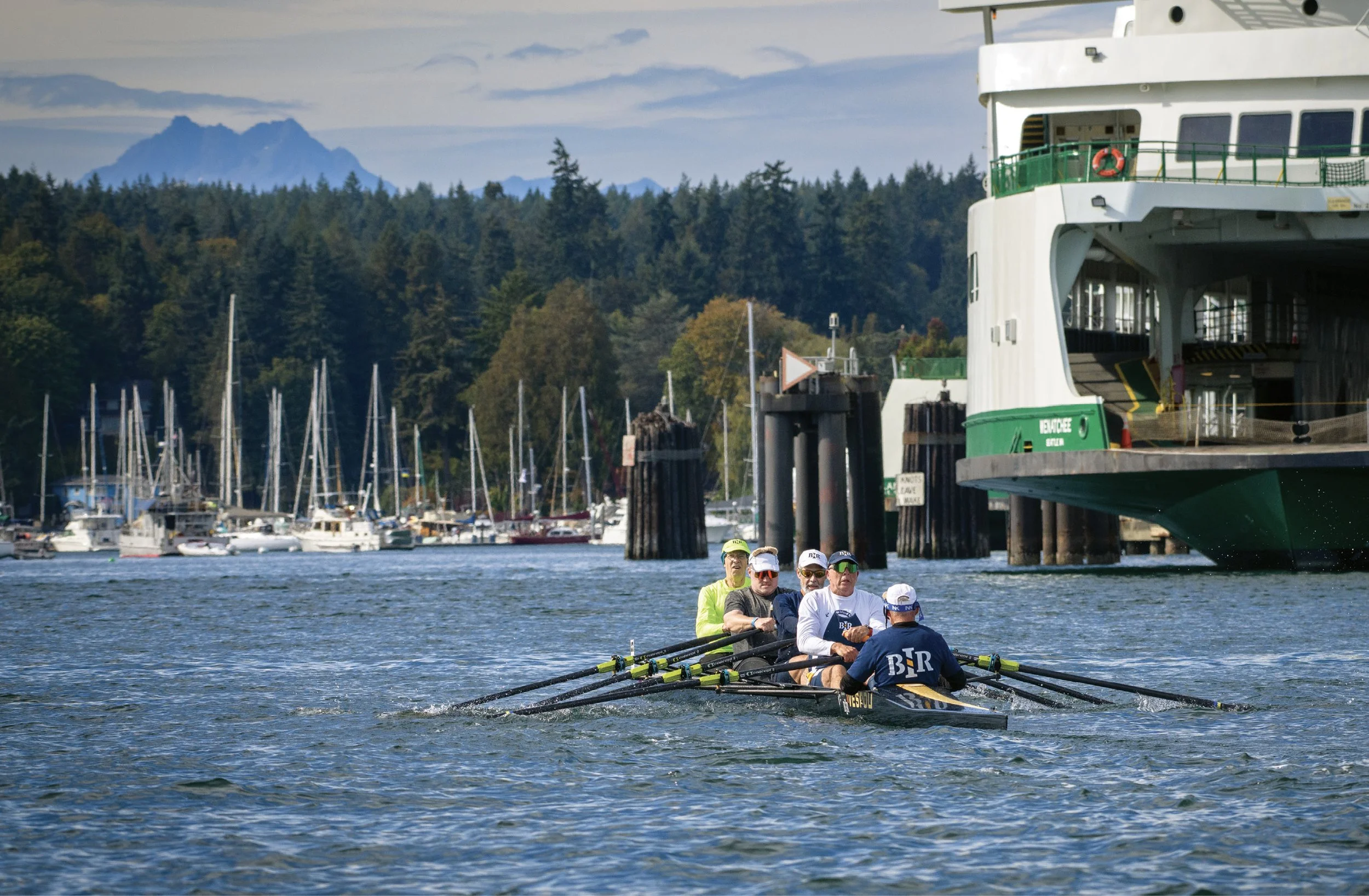
And there's a new gig in town: so-called "coastal rowing" is an adventure-focused specialization that uses more robust boats to open new horizons for exploration on more dynamic water. Rowers and coxswains need to be aware of tides and currents, course topography, know maritime traffic rules, and be prepared to handle (ahem) more exciting weather conditions. Think of it as hopping on a mountain bike after cycling on a flat road—more dynamic conditions and more areas to explore, requiring different skills. At the end of the day, though, it's all about the water and the community it fosters. When rowers sit around sharing coffee after practice, it's easy to see the shared connection between them. There's an intimacy from having woken up before the sun, launched boats in the dark and watched the sunrise together.
Walker Hauptman, BIR deputy director of rowing and varsity boys coach, puts it this way: "This space—these boats, this boathouse, this whole community—are specifically designed to be a safe place to try new things. And that can be a lot. You'll have great days, but other times you might be tired. Sometimes you'll be raw. In a way, you're baring yourself. You've put yourself in a position where you have to trust your teammates. You're going to be imperfect. But when you celebrate the wins and forgive yourself for the failures—that's when the magic happens."
From Injury to Invention
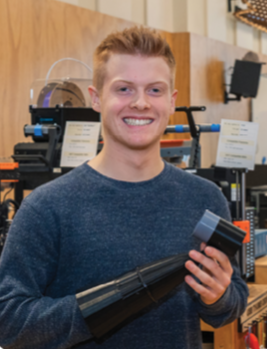
Rowing is everything to Mike Bromell. He discovered this passion when he joined Bainbridge Island Rowing as a freshman at Bainbridge High School.
During his sophomore, junior and senior years debilitating hip pain while rowing forced him to step away from the sport for periods of time. As a way of coping with the disappointment, he began thinking of how he might be able to help others who couldn't row due to injury or disability.
Bromell learned that few options existed for people with limb difference or arm amputations. Existing prosthetics were expensive and cumbersome. They also prevented the rower from "feathering" the oar—rotating it to make for a more efficient stroke—a critical move in a team setting.
So he decided to create one that would. Bromell first sought help from Bainbridge Artisan Resource Network (BARN), where his family had been members. He knew the Tech Lab had 3D printers, although he had never used one. Bromell taught himself rudimentary 3D modeling to construct early models. Tech Lab lead Keith La Plain stayed in the studio after school hours to help.
"Everything I did happened at BARN," Bromell said. "People were so helpful. When one of my 3D jobs went wrong, often I found another BARN member had restarted it for me. Eventually I got better and figured things out."
His completed project won its division in a Washington State Science and Engineering Fair. One of the judges strongly suggested he patent the device. "I did it because of my love for rowing," he said, "not to make money."
After three iterations, Bromell now has a finished 3D-printed prosthetic that prints for $1.20. He posted a size-adjustable file anyone can use for free on the internet and created a website sharing more info.
Now that he has the skills to design and print assistive devices, Bromell actively participates in a group called Makers Making Change. People who need a device for a specific purpose post a request online, and makers offer to take on the project. So far Bromell has created a penholder for a young girl with cerebral palsy, a playing card holder for a woman missing a hand and other projects.
Meanwhile, Bromell has undergone the first of two planned surgeries for his hip injury and hopes to be fully recovered and back in a boat by the spring of 2027. He's also accepted an offer to the school of engineering at Cornell University and is considering a biomedical engineering major, inspired by his prosthetic device experience at BARN. / Carolyn Goodwin