
working the tides
community shellfish farm cultivates shoreline stewardship
Words by Michele Bianchi
Photos by Cameron Karsten
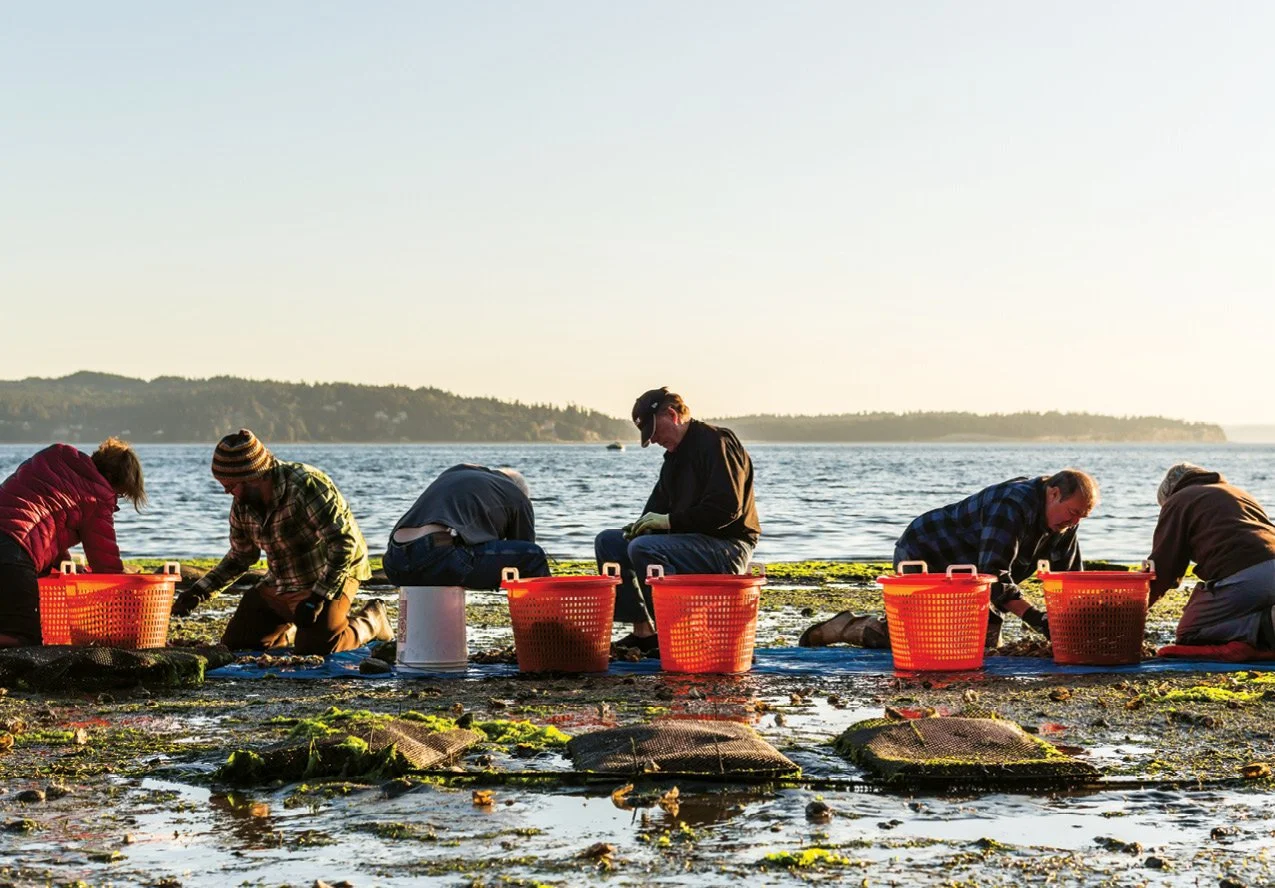
Walking down a gently sloped, tree-lined driveway toward the shoreline, a group of volunteers for Puget Sound Restoration Fund makes their way to the tidal flats and the water’s edge. A gull cuts across the sky, and the breeze carries a mix of salt and pine resin.
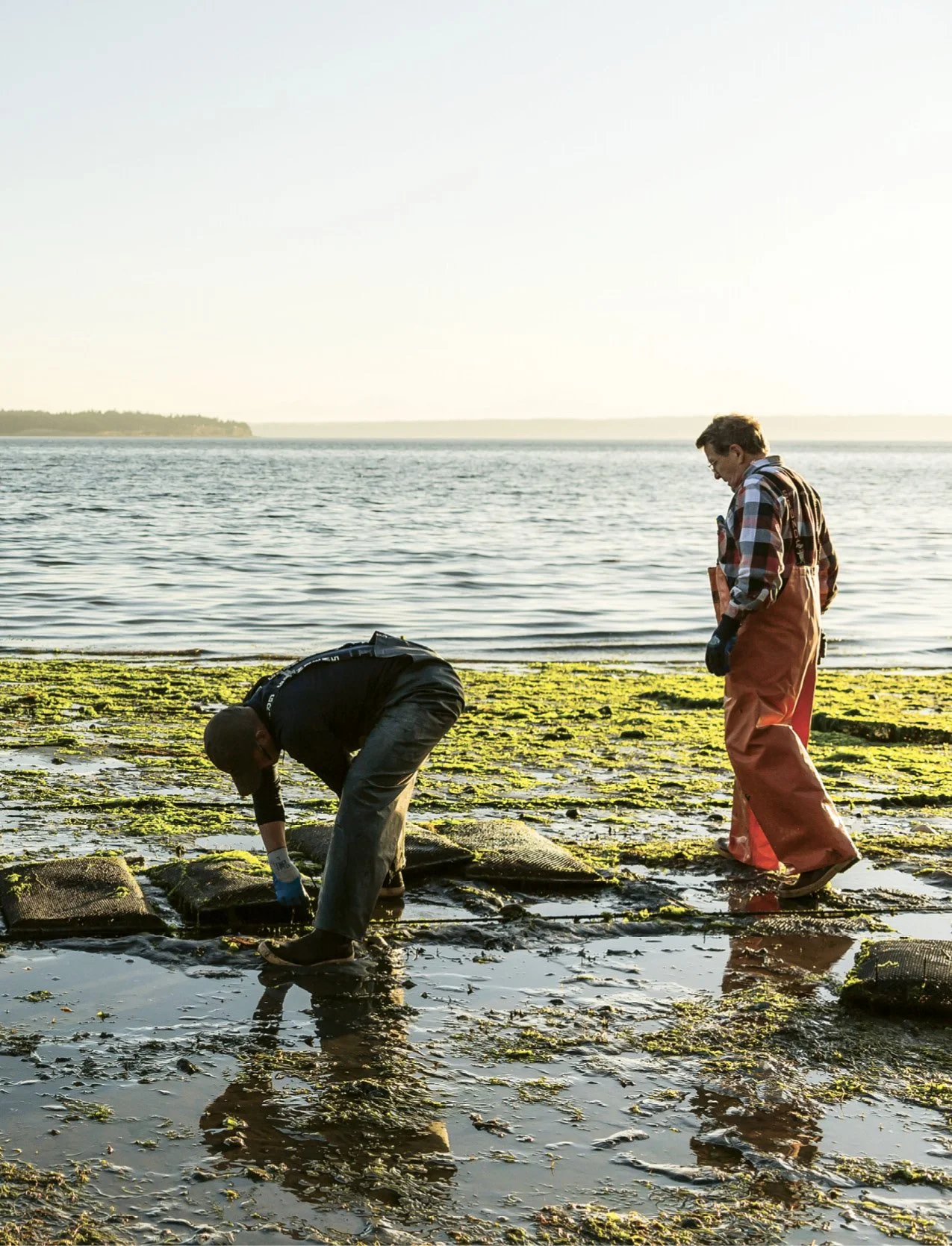
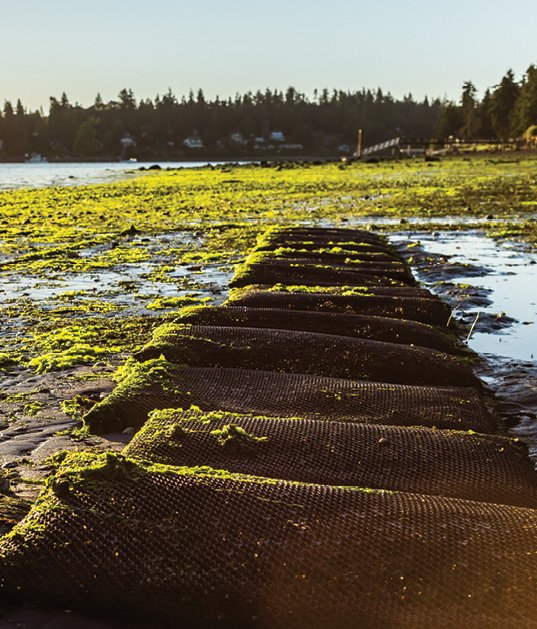
In the near distance are several long tarps and stacks of five-gallon buckets. Beyond them, exposed by the low tide, lies a necklace of large mesh bags anchored to the shore with rebar. They contain hundreds of pounds of Pacific oysters.
The volunteers walk down to the bags, drag them onto the tarps and turn them upside down. Oysters spill out, along with startled crabs that flip around and scatter across the sand. One by one, the volunteers crouch and begin sorting the oysters. Larger ones go into the harvest pile, while smaller ones go into a “keep growing” bucket.
The day’s outing takes place at the Port Madison Community Shellfish Farm (PMCSF), operated by Puget Sound Restoration Fund (PSRF). Founded in 1997, PSRF works to rebuild native species that once defined our region’s nearshore ecosystems and renew connections to resources that can still be harvested in local waters.
Over the past 28 years, PSRF has led projects restoring Olympia oysters to bays where they had nearly vanished, reestablishing bull kelp forests that provide underwater habitat and rebuilding populations of pinto abalone—a species so depleted that, without intervention, it likely wouldn’t recover. The organization partners directly with tribes, state agencies, local governments and academic researchers.
Its Community Shellfish Farm sits adjacent to Bloedel Reserve on Bainbridge Island and reconnects island residents with a long history of gathering food from these beaches through a Community Supported Aquaculture (CSA) model. As CSA members, households buy a seasonal share of the oyster harvest and join harvest events on the tideland from March through June.
That hands-on workforce becomes a multiplier of restoration efforts. Working directly on the beach helps participants form a tangible connection to the health of Puget Sound. What happens to the water no longer feels abstract. It’s become something they’ve touched and tended.
“IT’S REALLY ENCOURAGING TO SEE PEOPLE LOOK AT PUGET SOUND NOT JUST AS A PLACE WHERE THERE ARE BEAUTIFUL LANDSCAPES AND WATERWAYS, BUT AS PLACES THAT CAN STILL PROVIDE US WITH FOOD.”
Josh Bouma, manager of the farm, notes that the program extends beyond oyster harvesting. “We’ve done a good job getting our CSA members and volunteer group involved in other efforts, including a septic inspection program and regular water quality monitoring with the Department of Health,” Bouma says.
Those localized actions, along with education about proper pet waste cleanup and the contribution waste makes to bacterial contamination, help keep Port Madison approved for shellfish harvest. They also increase residents’ understanding of how Puget Sound functions as a living ecosystem.
Puget Sound is under real pressure from increasing water temperatures, nutrient-driven algal blooms, bacterial contamination and ocean acidification, which reduces carbonate availability for young shellfish as they form shells.
In response, PSRF’s approach combines science-based restoration work with civic education and community action. The CSA program, which recently earned a $6,000 grant from the Bainbridge Community Foundation, translates marine science into practice, giving residents a role in care, maintenance and observation at the water’s edge.
That approach reflects a deliberate philosophy: Ecological recovery succeeds only when surrounding communities understand and value what is being restored.
Shellfish harvesting in particular creates a visceral, lasting impression. “Seeing somebody out on the beach and tasting oysters for the first time—that’s been really fulfilling,” Bouma says. “Their eyes light up. The sweetness followed by ocean brine—it really does take on the character of the place where it grows.” By design, volunteers taste those oysters while experiencing the wind off the water and breathing in salt from the air. Bouma adds that the flavor is further shaped by the mineral-rich bluffs above the shoreline.
What begins as a flavor discovery slowly and quietly rewires how people relate to the place itself. By sorting oysters beside neighbors, kneeling in tidal mud and participating in a restorative cycle, members rediscover that food, environment and community are inseparable.
“The first time I slurped an oyster right there on the beach, I was hooked,” CSA member Ben McCafferty recalls. “It was delicious, of course, but it also made me realize that whatever we dump into the water is also going into that oyster. It’s been impossible not to think about the Sound as a living thing that needs care and protection.”
PUGET SOUND RESTORATION FUND OYSTER CSA 2026 SEASON
Location: Port Madison Community Shellfish Farm, Bloedel Reserve tidelands
Season: March – June
Number of harvest days: 5
CSA capacity: 75 members
Volunteer work parties:
Approx. 12 per season
20–25 volunteers per event
Harvest share options:
- Level 1 — $160 / 10 dozen
- Level 2 — $320 / 20 dozen
- Level 3 — $480 / 30 dozen
Sign-up: restorationfund.org/programs/communityshellfishfarms