
warp & weft
the revived art of coast salish weaving takes the spotlight
Words by Linda Kramer Jenning
Photos by Olya Blase
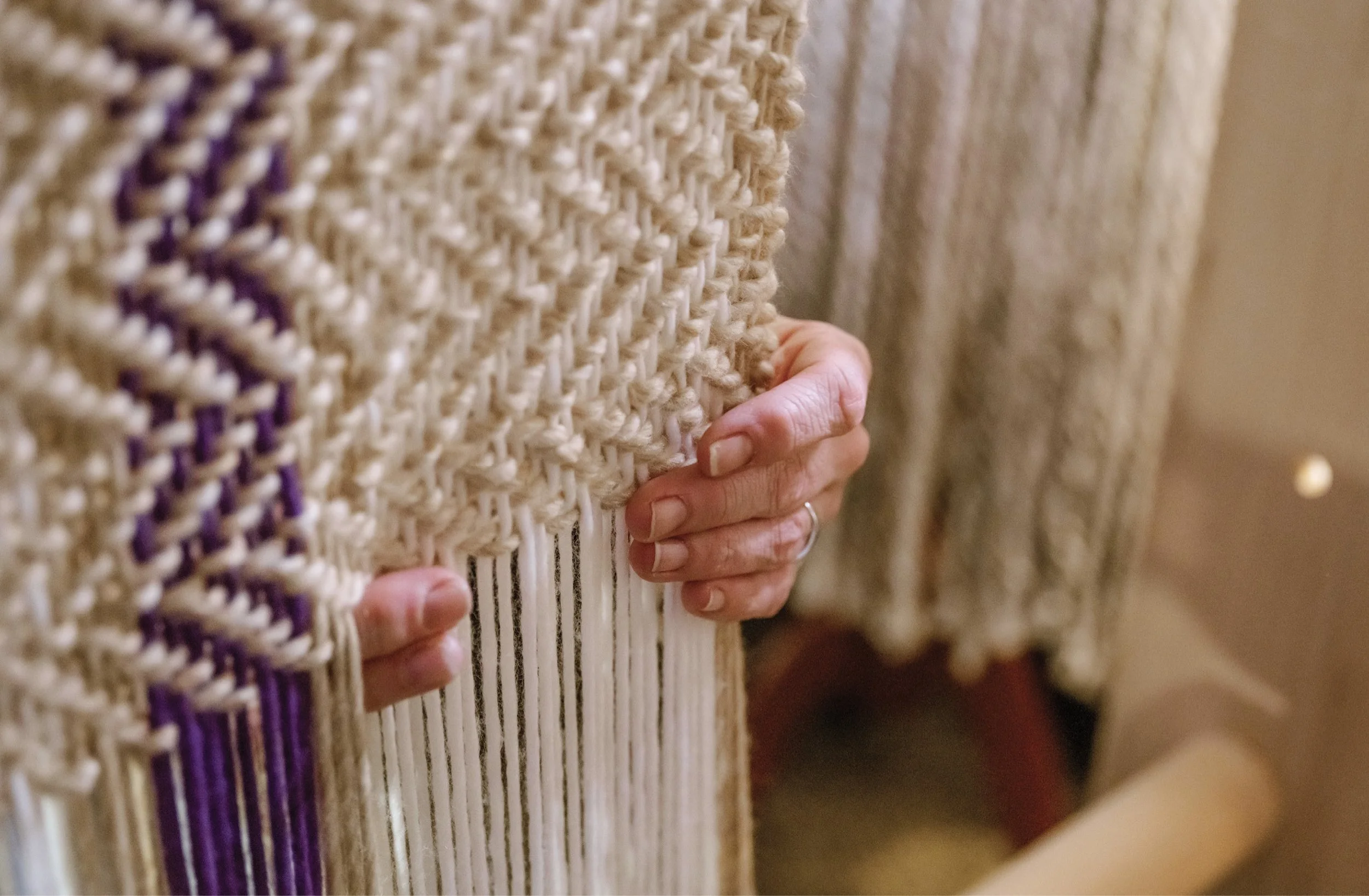
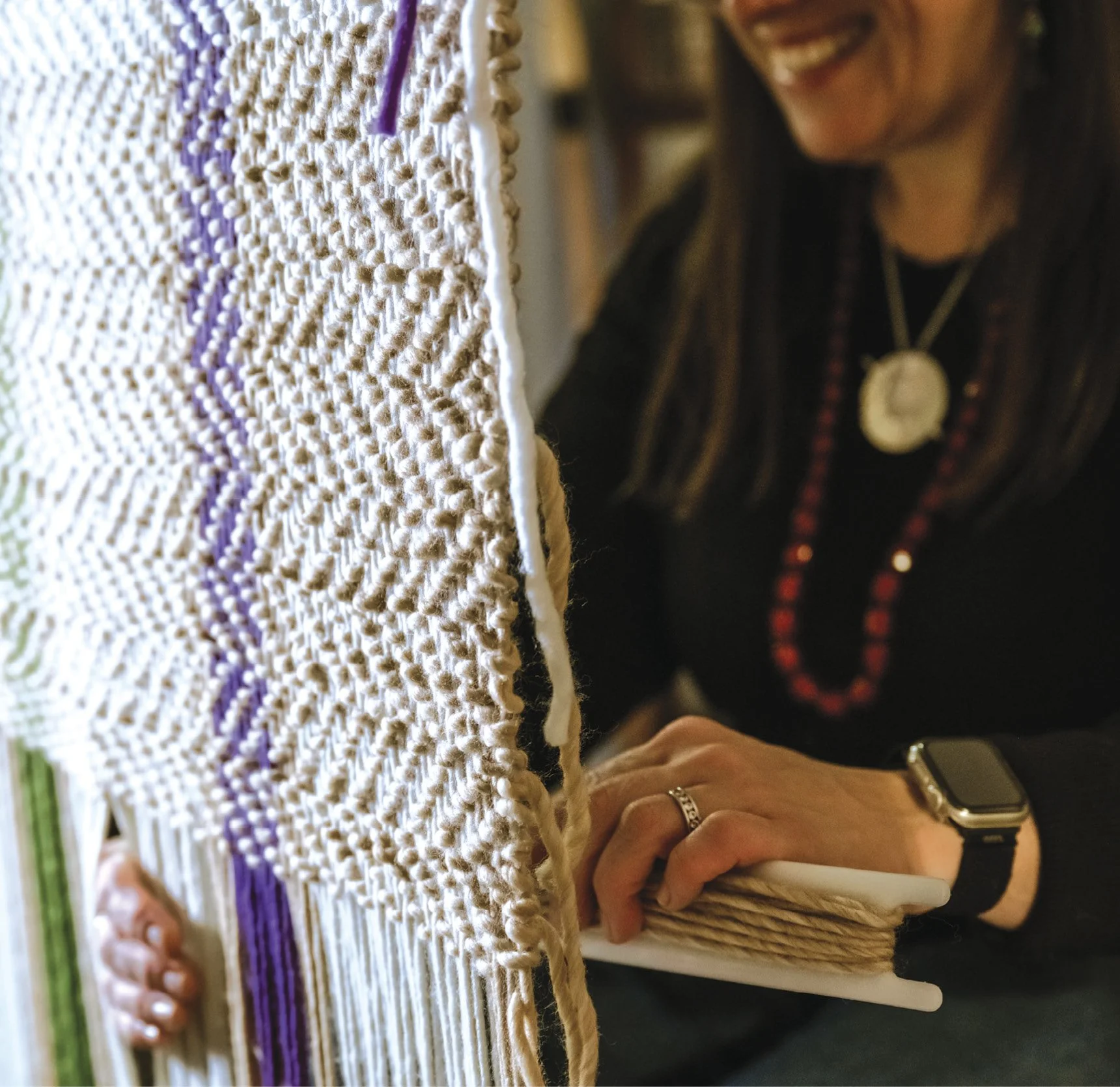
When Kelly Sullivan sits at one of the many looms in her workshop at her home on the Port Gamble S’Klallam Reservation, she feels the “ick of the world” fade away. She began weaving Coast Salish regalia a decade ago while seeking a more meaningful connection to her ancestors. She found it by learning to weave with the same materials, techniques and spiritual intent as her tribal forebears.
“I started weaving to have more of my culture,” says Sullivan, 47, executive director of the Port Gamble S’Klallam Tribe. “I wanted to make a piece of regalia for myself that is authentic to our tribe.”
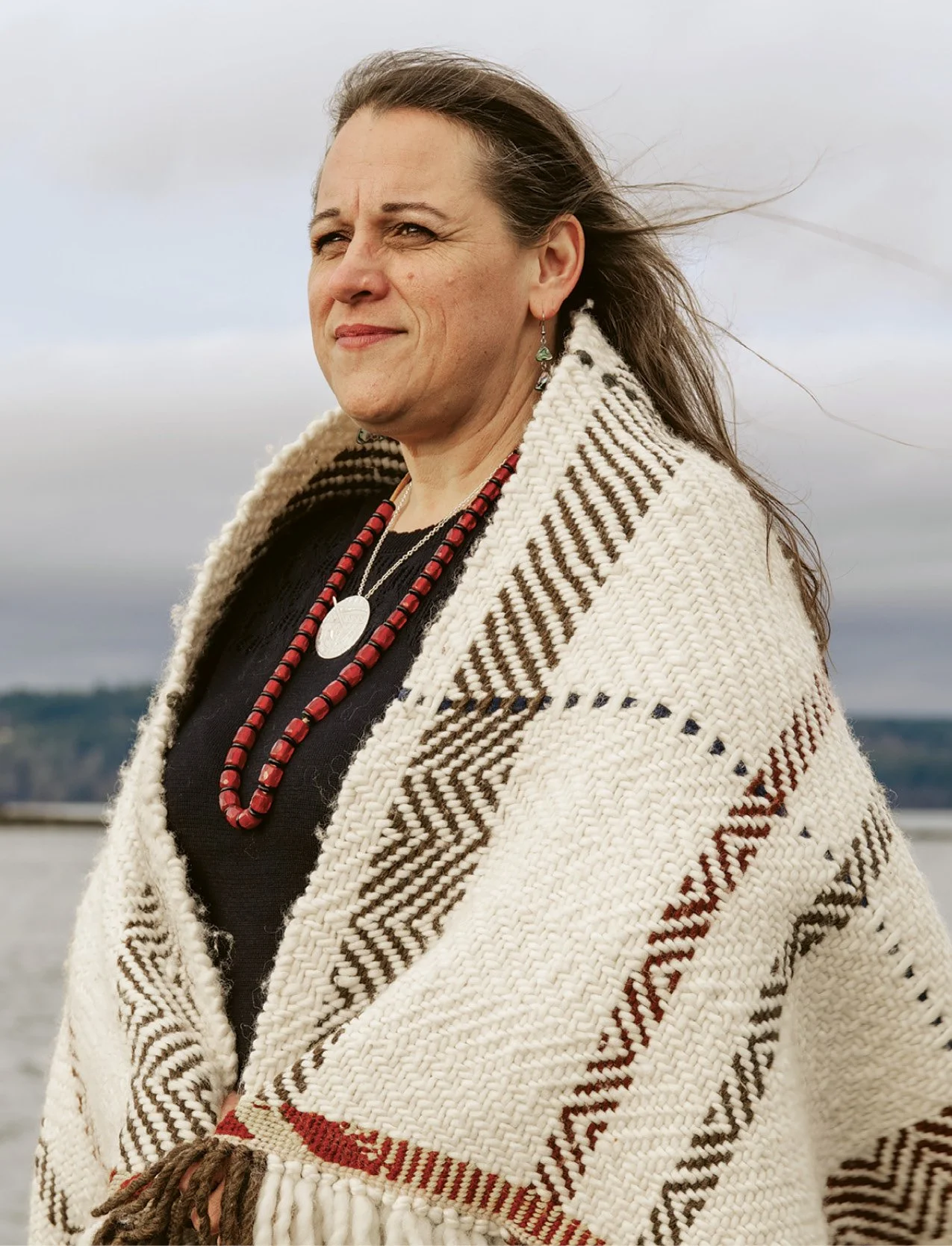
The regalia she has created includes a traditional Coast Salish shawl of mountain goat wool and alder cone that is now on display at the Burke Museum in Seattle in the exhibit Woven in Wool: Resilience in Coast Salish Weaving. The exhibit runs through Aug. 26 and features both artifacts and new pieces, like those woven by Sullivan and her contemporaries, as a testament to the skill and artistry of the Coast Salish people.
“We’re doing right by the ancestors, this is what we’re supposed to be doing,” Sullivan says. “Most of us, even tribal members, didn’t know about any of this and so the fact that it is getting attention is incredible.”
Sullivan wove the S’Klallam shawl featured in the exhibit using an overspun technique that she describes as magical. “When you are taking it off the loom, it feels like the weaving’s spirit is alive and visible because those braids spring back and you don’t need a knot. It’s like they have come to life.”
She learned the technique from Dr. Susan Pavel, executive director of the Coast Salish Wool Weaving Center, who has taught thousands of people how to weave in the traditional way. Pavel proposed an exhibit to the Burke Museum about five years ago.
“We were very keen to share that it’s not just a craft or a hobby, but that there’s deep meaning and purpose behind all our regalia,” says Pavel, who married into the Skokomish Nation and teaches fiber arts at the Evergreen State College and in workshops throughout the region.
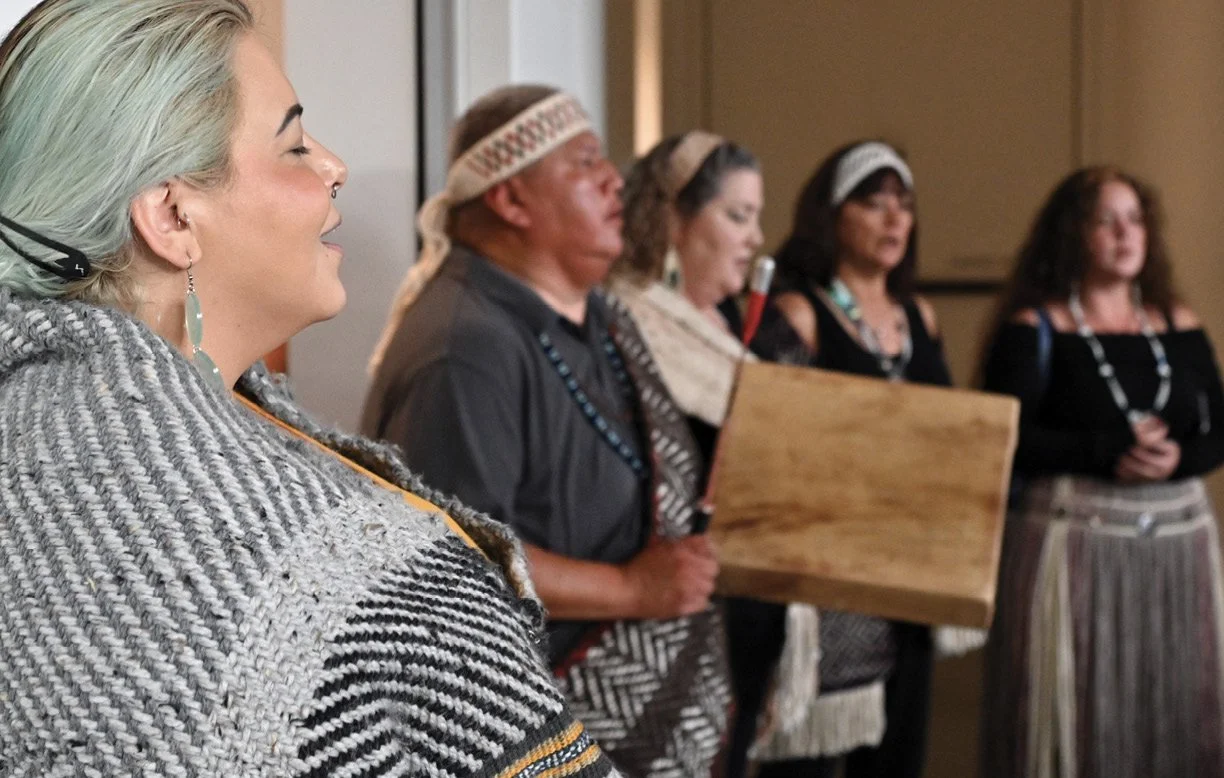
Pavel has been weaving since 1996, initially learning from members of her husband’s family. “I pretty much turned my life over to that and learned all that I could, then shared it back out,” she says. “I realized that it wasn’t a possession for me to keep. It was one link in a chain that was many links long. That chain of knowledge preceded me, and the chain of knowledge is going to live well past my lifetime. My purpose is just to be one strong link.”
She has studied historic weavings to identify their materials and techniques, then passed that knowledge on to her students. “The weavers who wove those weavings left teachings behind,” Pavel says. It’s incumbent upon our people today to learn from them, to hear their teachings and move that forward.”
Many of those techniques were forgotten over centuries as colonization introduced Hudson Bay blankets and other woven goods, leading to a decline in traditional Coast Salish weaving. But it never fully disappeared, and in recent decades, a revival has grown, largely due to the commitment of weavers like Pavel and Sullivan at the Coast Salish Wool Weaving Center.
“People yearn to know where they come from and to find something from their ancestral heritage that is authentic,” says Sullivan, “and when they do, they latch onto that.”
The Burke exhibit shows visitors how Sullivan, Pavel and other contemporary weavers forage to collect mountain goat wool, plants and other materials, and how they card, spin and dye the wool using customary tools. The display includes samples of other materials used in the weavings, including alder cone, red cortinarius mushroom, fireweed fluff, nettle and deer antlers. Accompanying videos mix historic footage with scenes of contemporary weavers—highlighting the spirituality that connects today’s weavers with their ancestors.
“It’s really exciting to have a chance to highlight the long traditions of weaving and women’s knowledge that come from this territory right here in Washington state and Southern British Columbia,” says Katie BunnMarcuse, curator of Northwest Native Art at the Burke Museum.
She says the museum’s relationship with the weavers was built over many years, including when Sullivan did an apprenticeship with Pavel in 2018, supported by the Burke’s Bill Holm Center for the Study of Northwest Native Art. “I hope people get a sense of the incredible time, over many seasons and years, that goes into making these weavings,” Bunn-Marcuse says.
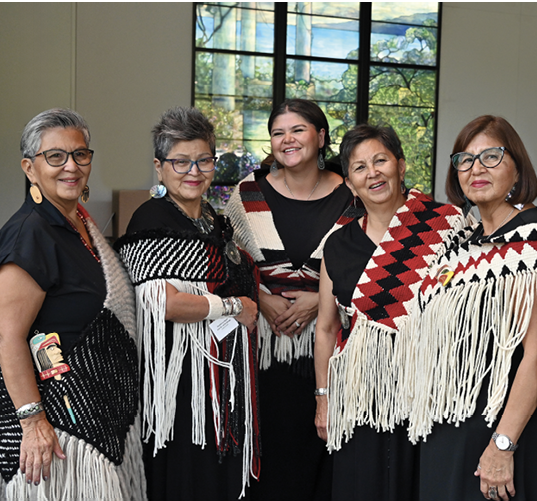
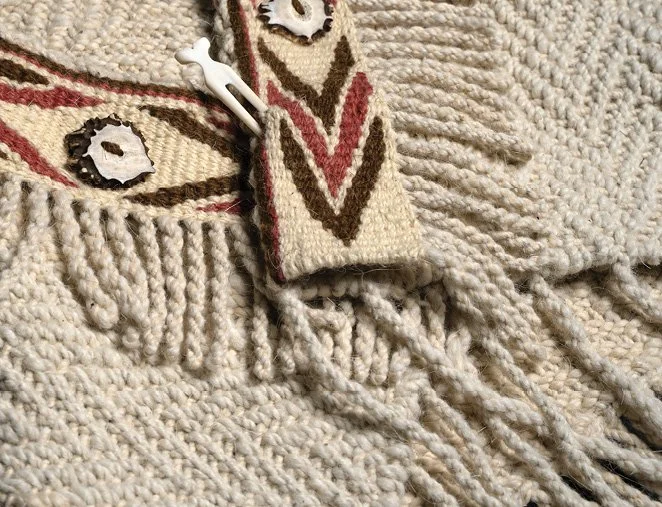
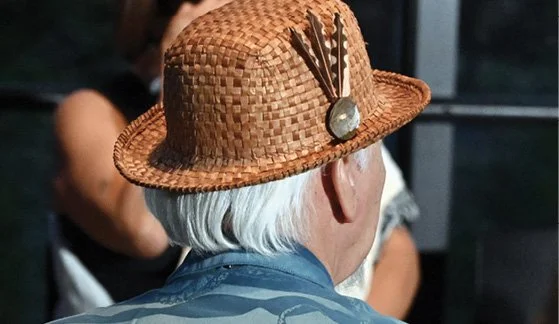
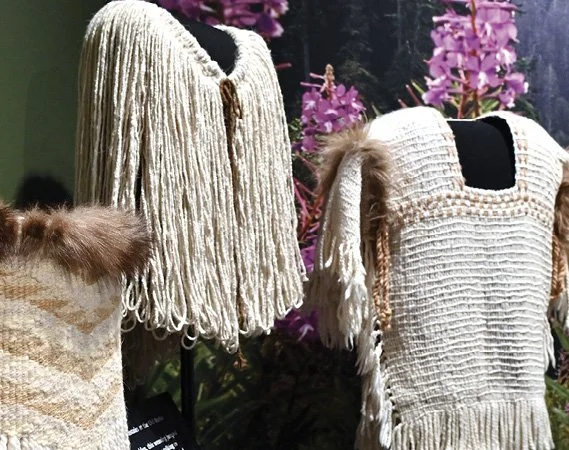
The exhibit includes pieces already housed at the Burke as well as artifacts from museums in British Columbia, the Field Museum in Chicago, the American Museum of Natural History in New York City and the Smithsonian in Washington, D.C.
Among them is Mutton, the hide of an extinct wool dog. Mutton belonged to an ethnographer who had spent time with the Coast Salish over a century ago. When the dog died, he preserved the pelt and shipped it to the Smithsonian. It sat there ignored until a researcher studying the wives of explorers found a letter mentioning Mutton and prompted officials to find the hide and have it tested. Scientific analysis confirmed in 2023 that it came from a Salish wool dog, long considered folklore.
“Until recently the Coast Salish wool dog existed in oral history,” says Sullivan. “Now it’s scientifically validated and proven that it existed. The only known specimen of a pelt is at our exhibit. Mutton is home.”
Sullivan’s weaving journey began about a decade ago when she was seeking a more meaningful way to engage with her tribal culture. She grew up on the reservation and went to work for the S’Klallam Tribe after studying community health education at Central Washington University She later served on the tribal council and became executive director in 2011, after completing her graduate degree in public administration from The Evergreen State College.
When she found Pavel and took her class, Sullivan says weaving “bit me, and after that I just kept going.” She began to acquire her own looms, from small frames to one nearly ceiling-high, with her partner Nick Miller helping to craft them mostly from pine and cedar.
“When you’re at the loom, you’re supposed to be in a good way, with a good heart. You have to be relaxed or else it doesn’t work. If you’re not in the right space, it won’t come out right,” says Sullivan. “For me, it helps channel out the ick of my life,” she adds. “It’s helped me through some really tough times. When you can’t sleep and you get up and you put a few lines in, you really do sometimes find answers to your problems. The best description is that it’s meditative.”
What is a loom?
Salish weavings are made by interlacing warp and weft threads. The vertical warp is one continuous thread wrapped over the top and bottom bars of the loom many times and set in place at the beginning, when the loom is “warped up” by the weaver. The horizontal weft is the active element during weaving, moving behind or in front of the warp to create patterns. The weft can change color as needed for the design. / Burke Museum
Nod to tribal design
The Seattle Sounders are sporting a new look on the pitch this season. The soccer club has collaborated with tribal weaving artists from the Muckleshoot, Puyallup and Suquamish Tribes to design a special edition jersey with coordinating shorts, socks, scarf and tribal flair. Sounders players will wear the “Salish Sea Kit” during the 2026 Major League Soccer season to honor indigenous culture and advocate for the future of the Salish Sea.
“It’s really a beautiful thing that happened, because it was three generations of women, three different voices, from the tribes that represent the region,” Danielle Morsette, a member of the Suquamish Tribe, told Underscore Native News.
The Sounders enlisted Morsette and fellow artists Gail White
Eagle of the Muckleshoot Tribe and Connie McCloud of the
Puyallup Tribe to collaborate with a design team at Adidas
who produced the kit. The jersey’s deep blue and green
geometric design reflect traditional Coast Salish colors and
weaving patterns. Printed on the bottom corner of the jersey
is the Lushootseed phrase
x̌ ax̌ a
ʔ ti qʷu
ʔ, meaning “water
is sacred.” Morsette, an accomplished artist, worked with a
Suquamish language teacher on the phrase. Her handcrafted
tribal regalia and commissioned public art are featured at the
Seattle Convention Center as well as Seattle and Portland Art
Museums. / Alorie Gilbert

Double-click to edit...