
woolf in the woods
IslandWood's senior naturalist on finding joy in nature
Words by Alorie Gilbert
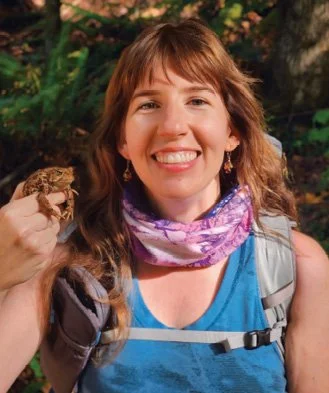
As a certified master naturalist, Christina Woolf ’s happy place is outdoors, inspecting mushrooms, looking for rough-skinned newts and gazing up at ospreys in flight. What gives her even more satisfaction is sharing her observations about the natural world with other people, which she’s been doing for nearly two decades at IslandWood on Bainbridge Island. As community education manager and senior naturalist at the 250-acre environmental education center, Woolf is known for delivering scientific know-how with engaging wit and enthusiasm. She also has a soft spot for frogs.
How did you get started in ecology? I was raised in a working-class New York family with an old-timey relationship to the outdoors. We learned food webs, seasonality, migrations and phenology by living close to the land as it sustained us. Nature wasn’t something we just visited.
You bring a playfulness to your work. Is that intentional? It’s intentional because it’s authentic. I make meaning through play and humor, and as a New Yorker, subtlety is not my brand. I lead with heart and candor. When people are having fun, they relax, lean in and actually learn. Joy turns out to be very effective pedagogy.
How do you get kids excited about the outdoors in our modern digital world? It’s surprisingly easy, especially if you’re not the parent (ha-ha!). Showing genuine curiosity and a little bravery goes a long way. Humans are inherently curious apes.
How can tech enhance engagement with the natural world? Apps like iNaturalist, eBird and Merlin Bird ID are like carrying thousands of very patient mentors in your pocket. Scientists I’ve never met critique my observations—in a good way. They’ve taught me to photograph mushroom undersides and learn liverwort anatomy. Tech doesn’t have to replace noticing. It can deepen it too.
What are some other ways families can connect more with nature? Walk your neighborhood. Get curious. Use the phrases: “I notice,” “I wonder,” and “it reminds me of...” Try it for a week. You don’t need pristine wilderness. You need attention, curiosity and a willingness to build a relationship with the wild world around you.
What’s a master naturalist and why become one? A Washington state naturalist is someone formally trained in place-based ecology through a structured certification program. I was drawn to it because I wanted to deepen my understanding of Washington’s ecosystems and watersheds and strengthen the ecological foundation behind the work I do in science education. I loved being back in “school” again!
What was one highlight of the program? I got to meet Kitsap legend Mary Earle from the Clear Creek Task Force. She is a powerhouse! We planted trees along Clear Creek with families on a rainy Saturday in October. It was inspiring to learn about the restoration of Clear Creek trail and hear how it’s come back to life (salmon included) with the hard work of many volunteers.
What keeps you excited about your job? IslandWood stays exciting because the work is iterative and community-driven. We listen, adapt, and turn curiosity into hands-on learning alongside incredible partners. It doesn’t hurt that most of us sincerely love frogs too.
Do you have more personal or professional goals? I’m always turning over a new leaf, or log. Through my business, Wild Bainbridge Island, I lead guided walks on public and private lands, tutor natural history and create custom field guides. I want to build a living compendium of Bainbridge’s biodiversity so people truly know what we have here and choose to protect it.