
historic harvest
Restoration of an island orchard connects people to history, the land and one another
Words by Michele Bianchi
Photos by Brittany Kelley
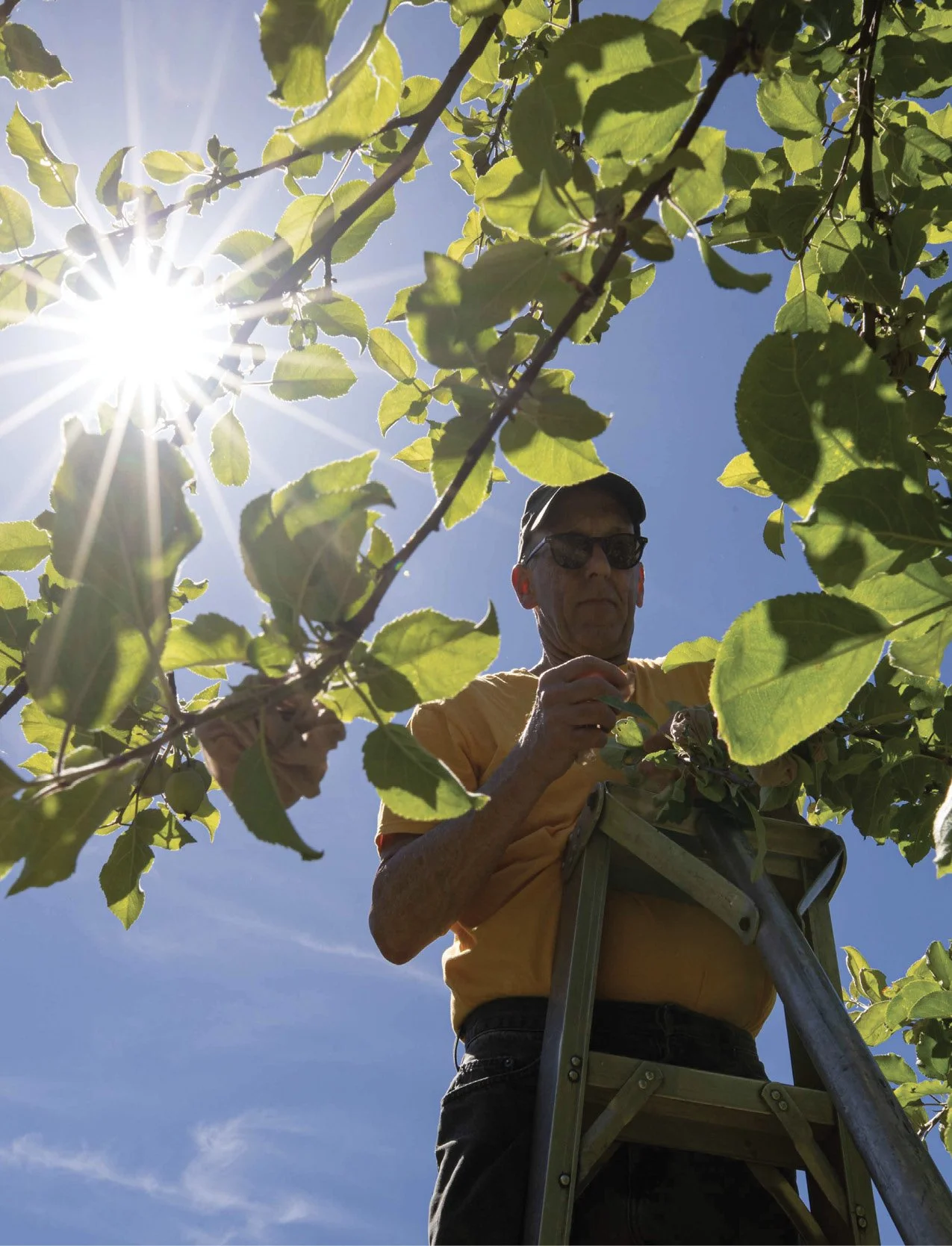
Mark Ashley of the Bainbridge Island Fruit Club wraps apples in protective netting at Johnson Farm. The club donated 130 lbs of fruit to Helpline House last year.
At first glance, the fruit trees on Johnson Farm resemble gnarled, weathered hands reaching skyward.
Their twisted branches bear the marks of decades exposed to wind, rain and Pacific Northwest winters. Some trees in the historic orchard seem to hold themselves upright through sheer determination. Others bear the scars of grafts, their branches protruding like bulging knuckles.
Darren Murphy, president of the Bainbridge Island Fruit Club (BIFC), doesn't see an aging orchard. He sees 10 years of experimentation etched into the orchard itself—multiple varieties growing from a single trunk, grafts that never took hold and branches scarred by anthracnose, a fungal disease. Standing beneath an aging Red Delicious apple tree, he points to branches carrying different varieties of
apples. Many orchardists would have replaced the tree years ago. Instead, Murphy and other volunteers saw an opportunity. "If you have a nice rootstock, why cut down the tree and start over?" he asks.
Over the past decade, members of BIFC have been restoring the orchard at Johnson Farm, a nearly 15-acre public property owned by the City of Bainbridge Island. Signs placed throughout the orchard explain grafting techniques, orchard restoration and the history of the farm itself.
The orchard is just one chapter in the farm's much longer story. The Johnson family established a homestead in 1888 and the farm remained in family hands for generations. After returning home from military service during World War II, Harvey Johnson—grandson of the original homesteader—began planting fruit and nut trees, the foundation of today's orchard.
The future of the farm became uncertain after Johnson's death in 2000. Plans were proposed to subdivide the remaining acreage into residential lots. Instead, honoring Johnson's wish that the land remain available for agriculture and public use, the farm was preserved through a partnership involving the City of Bainbridge Island, the Trust for Public Land and the Trust for Working Landscapes, now known as Friends of the Farms.
When they began working in the orchard, volunteers encountered mature trees that had spent decades adapting to Bainbridge Island's soils and climate. Through pruning and grafting, club members introduced new varieties onto existing trees, slowly reshaping the orchard while preserving its character. Today, more than 30 apple varieties grow on approximately 10 of the trees. Some trunks support multiple varieties, creating a collection that ripens throughout the season and offers visitors apples rarely found in grocery stores.
Walking through the rows, BIFC Director of Communications Mark Ashley points out varieties with names likely unfamiliar to grocery shoppers—Winter
Banana, William's Pride, a Dutch varietal called Karmijn de Sonnaville.
"We're not into production," Ashley says. "We're into preservation." The goal isn't simply to keep old trees alive, but to preserve the diversity, knowledge and sense of curiosity that comes with them. From the beginning, the project has served as a place to experiment and learn.
Ten years into that "grand experiment," as Murphy calls it, the orchard continues to evolve. The fruit club now donates fruit harvested from the property to the food bank at Helpline House. It's also in conversations with Bainbridge Prepares about preserving local food systems and fostering community resilience.
The orchard is also a place to share. Johnson Farm is open to the public, and visitors are encouraged to harvest ripe apples, plums, pears and nuts in the fall for their own use. (The exception is fruit protected by netting, which volunteers reserve for donation to Helpline House.) The arrangement reflects the orchard's larger purpose: not simply growing fruit, but connecting people to the landscape and the food it produces. What began as an effort to save an aging orchard has grown into something larger—a public space where people can learn practical skills, connect with local history and participate in the stewardship of a working landscape.
more than an orchard
When community members came together to save Johnson Farm from development more than two decades ago, they preserved more than a historic orchard. Today, the property supports a variety of uses. In addition to the restored orchard, Johnson Farm is home to 14 community P-patch garden plots, commercial farming operations run by Vireo Farm and Butler Green Farms, and a Little Lending Library focused on food and farming.
Its impact extends beyond the property itself. Through partnerships involving Friends of the Farms, Bainbridge Prepares, Helpline House and other community organizations, Johnson Farm has become part of broader conversations about local food systems, education and community resilience. Those relationships are producing tangible results. Last fall, volunteers harvested more than 130 pounds of apples and pears from the orchard for donation to Helpline House. Workshops, volunteer events and educational programs, including fall fruit tasting in October, continue to introduce residents to fruit growing, gardening and local agriculture.
"In saving the orchard, BIFC created a gathering place, providing neighbors with local food while preserving history," says Heather Burger, executive director of Friends of the Farms. "Their work reflects our belief that farmland is not just a resource to be managed, but a living asset that strengthens our whole community." / Michele Bianchi
farms fighting hunger
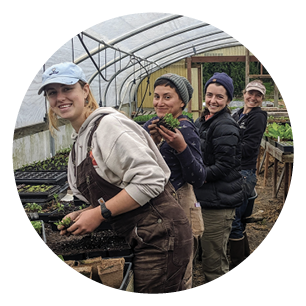
Full Tilth Farm, run by farmer Renee Ziemann (far right), is among the many farms participating in Kitsap County’s farm-to-food-pantry programs.
In response, Friends of the Farms on Bainbridge Island launched Share the Harvest in 2025, raising over $70,000 to keep Helpline House supplied with food from 10 participating growers. The ongoing campaign—supported by grants from the Bainbridge Community Foundation, the Lewars Foundation and the Rotary Club of Bainbridge Island—sent 12,000 pounds of local food to the food bank last year. "It was a big hole to fill," says Friends of the Farms Executive Director Heather Burger, who leads the charge. "Everyone responded; they were so incredibly generous."
More than 400 island families depend on Helpline House for food each week—twice as many as two years ago, Burger notes. "These are our neighbors—working families, seniors on fixed incomes, single parents and people dealing with illness," she says. "It could be anyone that finds themselves in need of food assistance."
In the same spirit, the Kitsap Conservation District (KCD) has teamed up with WSU Kitsap Extension to launch Kitsap Farmers Fighting Hunger. The fundraising campaign started in response to significant cuts in federal funding for local food purchasing. Donations support the Kitsap Farm to Food Pantry Program, which supplies eight local food banks with more than 100,000 pounds of produce, meat and eggs purchased annually from approximately 15 local producers—one of nearly 30 such programs in the state.
"Every dollar supports farmers, feeds our neighbors and strengthens our local food system," says Diane Fish, who spearheads the program at KCD. KCD itself grows and donates 20,000 pounds of fresh produce every year through the GRACE Garden Project, its one-acre organic farm in Poulsbo. The organization is also helping to launch Fishline Farm, a two-acre plot at the historic Peterson Farm in Silverdale that Fishline food bank recently leased to grow food for neighbors in need. The Great Peninsula Conservancy acquired the 142-acre property in Clear Creek Valley last year to preserve farmland in Kitsap County. / Alorie Gilbert
Photos courtesy of Full Tilth Farm.
did you know?
The City of Bainbridge Island owns 60 acres of public farmland, 21 of which are leased by multiple farmers who help preserve the island's agricultural heritage, strengthen local food systems and manage resources collaboratively. The land includes three notable properties: Johnson Farm, where Bainbridge Island Fruit Club maintains a historic orchard; Bainbridge Island/Suyematsu Farm, one of the oldest continuously operated farms in Western Washington; and Morales Farm, the site of three tiny homes that house local farm interns.
Among the farms leasing land on the properties are Butler Greens, Bainbridge Vineyards, Laughing Crow Farm, Perennial Vintners, Peaceful Morning Farm and Vireo Farm. "They're all using sustainable, organic practices and doing everything to make sure the soil will continue to produce food in the long term," says Clare Menard, who recently assumed the role of public farmland manager for the city. "It's pretty incredible the amount of work and love these farmers are putting into the land."
For a glimpse of some of these bucolic working landscapes, explore the public trails that border Bainbridge Island/Suyematu Farm and neighboring Morales Farm. Along The Farm Trail, a newer half-mile section that runs from Day Road to Lovgreen Road, amblers can enjoy colorful autumn views of rolling fields, pumpkin patches and grape rows. Parking is available at Grace Episcopal Church (except on Sundays) and at the end of Charles Place NE. / Alorie Gilbert
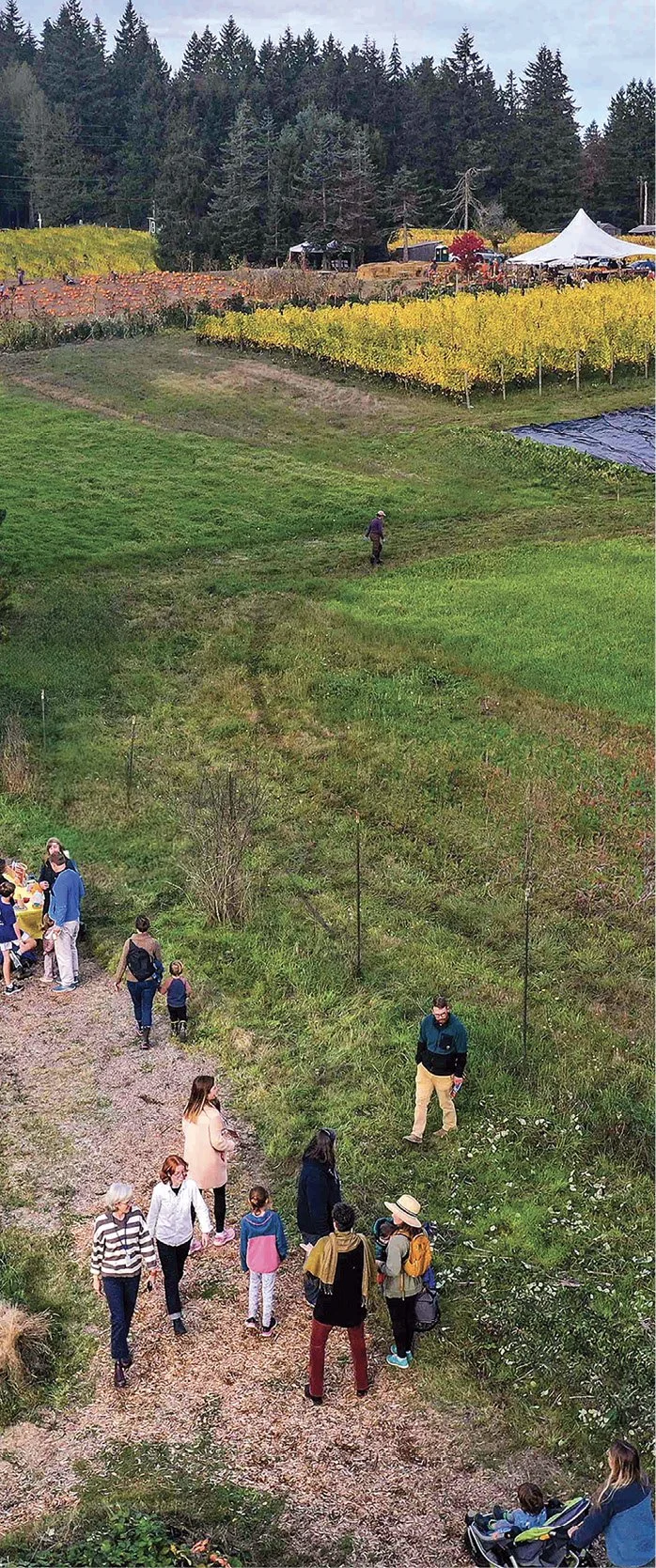
The Farm Trail is part of Bainbridge Island's 60-acre farm district and made possible by collaboration among the Parks & Trails Foundation, the City of Bainbridge Island and Bainbridge Metro Parks. (Photo: courtesy of the City of Bainbridge Island)