
bear necessities
Words by Paula MacKay
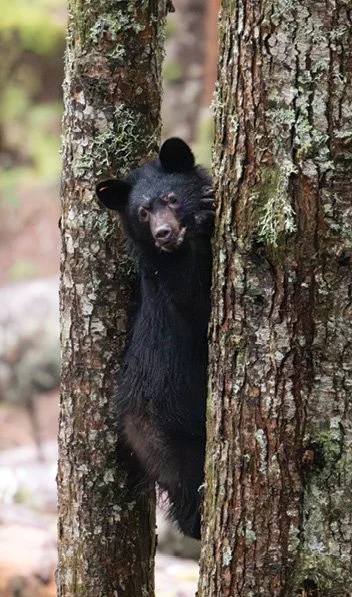
A rehabilitated black bear cub returns to the wild.
(Photo: PAWS Wildlife Rehabilitation Center)
Two summers ago, I was driving on Bainbridge Island when I braked for a dark blur running across the road. My initial concern about a stray dog morphed into excitement as I watched a black bear peer back at me from the leafy shoulder and then disappear into the forest.
My husband and I occasionally encounter black bears when we're hiking in the Olympic Mountains, but observing a bear close to home is always a surprise. The island isn't large enough to support resident black bears, which need more space to find food, mates and secure habitat for hibernation. So how and why do black bears come to Bainbridge?
"They probably swim," says Lindsay Welfelt, bear specialist with the Washington Department of Fish and Wildlife. The Kitsap Peninsula does support black bears, which are perfectly capable of bear-paddling Agate Pass or other narrow stretches of Puget Sound. Welfelt notes that a wandering black bear is "typically a young one trying to figure out what it's going to do with its life," with subadult males traveling many miles from their birthplace to establish territory of their own (females tend to settle down closer to mom). Only bears can know why a trip to Bainbridge might be worth taking the plunge, but they're no doubt hungry when they arrive, and their adventurous appetite sometimes leads them to the leftovers we throw away.
"Garbage is at every single person's house, and most places don't have bear-proof garbage cans," Welfelt says. "If a bear does show up on Bainbridge Island, as soon as it starts getting into those cans, it's going to keep trying." I saw proof of this pattern in my own neighborhood in June. One morning, a friend sent me a photo of a black bear rummaging through bottles and wrappers next to a knocked-over bin. The following day, I noticed a similar trail of rubbish on a nearby street. Welfelt points out that bears can get into trouble when they're rewarded with trash and lose their fear of people, potentially putting themselves and us at risk. Relying on garbage causes health problems for bears, and can lead to their being killed by wildlife officials. Such "conflict bears" might leave orphans behind, with nobody to teach them how to forage or stay out of harm's way.
Each year, the PAWS Wildlife Rehabilitation Center in Snohomish takes in several black bear cubs presumed to have lost their mother to human conflict, hunting, a wildlife-vehicle collision, den disturbance or some other cause. "The majority of times, we just know there is no mom around and there should be," says Emily Meredith, the center's associate director. PAWS receives cubs from all over the state, including the Kitsap Peninsula. Regardless of how the cubs end up as rescues, the center's goal is to release them back into the wild. "We provide them the tools to learn how to hone their instincts," Meredith tells me, emphasizing that their approach is totally hands-off. "We want them to be like wild bears when they go."
PAWS raised and released an orphaned cub from Poulsbo in 2019 and another in 2021. Injured adults pose more significant challenges, like the 260-pound female that was struck by a vehicle near Poulsbo in late 2018. The bear's fractured pelvis required five hours of surgery, conducted by veterinarians at Woodland Park Zoo. Miraculously, she recovered at PAWS and was able to roam free again.
Rescue stories are a bright spot for black bears, but the best thing we can do for them is to prevent conflicts in the first place. If you know there's a bear in your area, take in bird feeders and secure your trash—a good practice for coexisting with raccoons and coyotes, too.