
new faces of tribal tradition
Three Suquamish women brave the perils of diving for geoduck
Words by Linda Kramer Jenning
Photos by Brittany Kelley
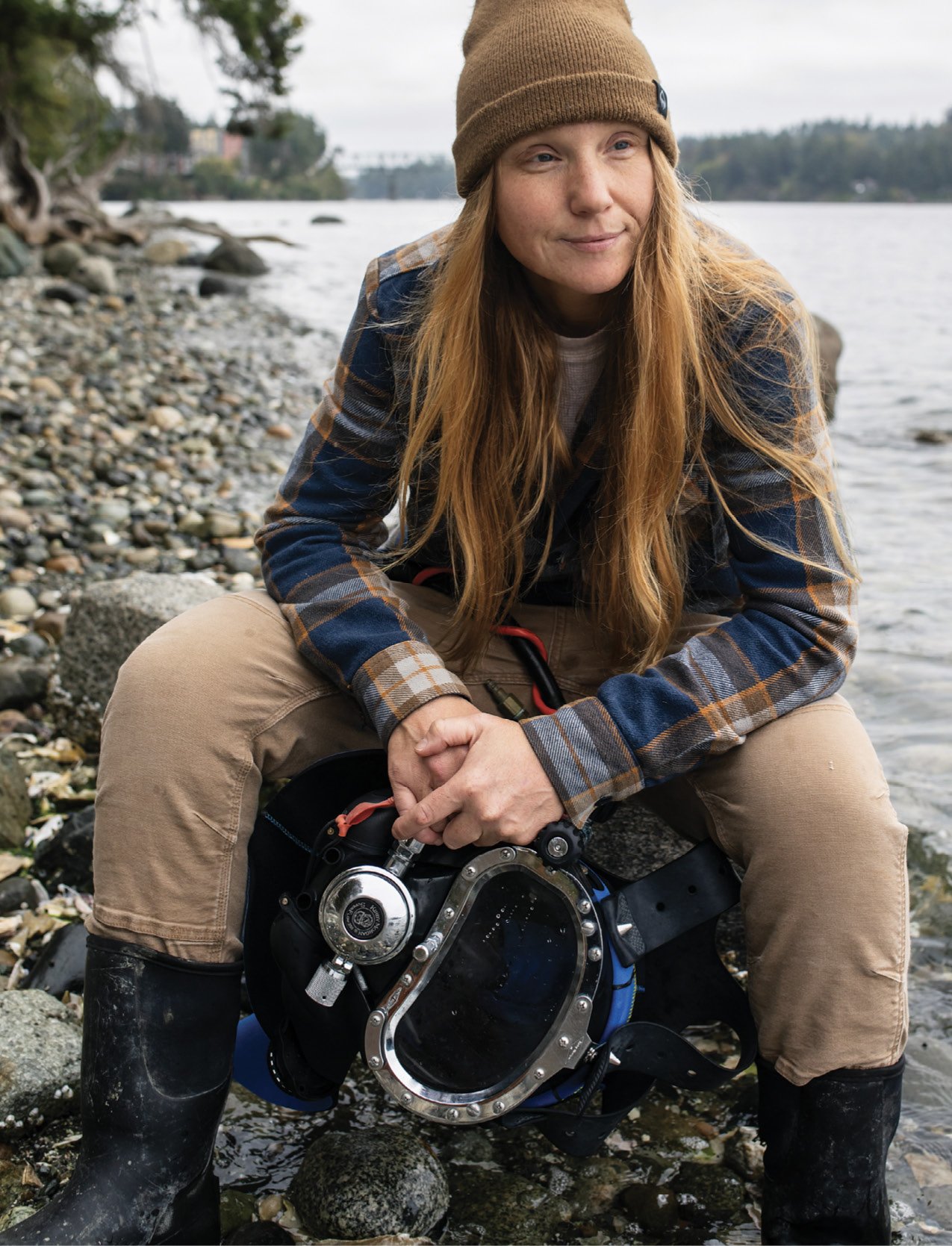
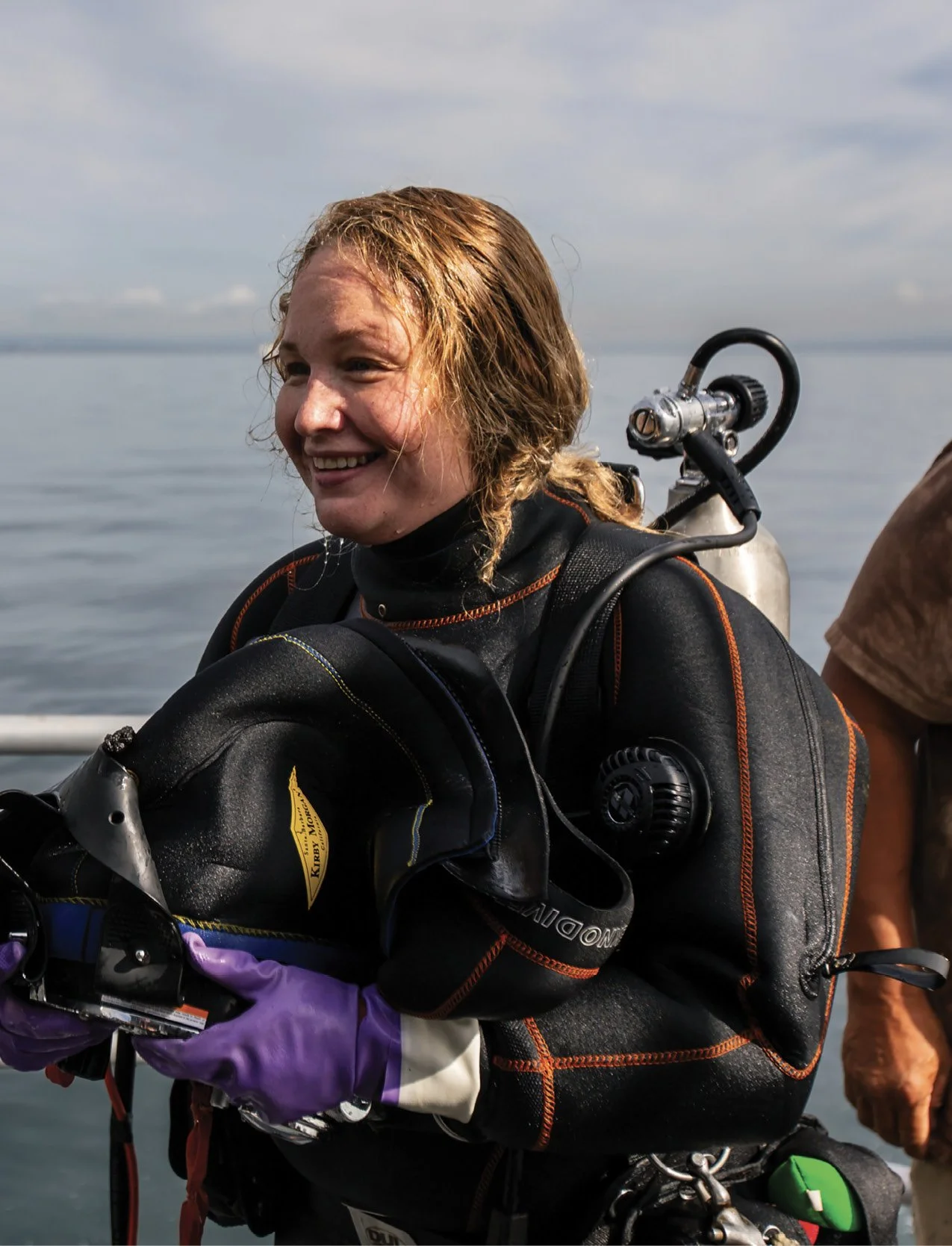
Suquamish Seafoods diver Heather Purser
To get to her workplace, Jennifer Hess plunges into Puget Sound and dives down 55 feet or more where, like an underwater ninja, she hunts down and wrests from the sand the inimitable bivalve of our region: the geoduck.
She is one of three women geoducks divers for the Suquamish Tribe whose treaty rights to the meaty mollusks were secured by federal court rulings. While not that popular on restaurant menus here, wild geoduck is a delicacy prized by the Chinese and big business for the tribe.
The tribe uses a lottery system to select its divers. Hess entered the lottery and says it was years before her name was pulled for one of the tribe's 25 coveted diving spots.
"It's not a common job, and it's even less common for women to be doing it," says Hess, 44, who was a stay-at-home mom when her name was selected. "I went through my training, and I fell in love with it. I wish I'd been doing it my entire life. I can't even explain the feeling of what it was like the first time underwater. It just felt like I belonged there. The Puget Sound is like a second home to me."
While geoduck diving remains dominated by men, the Suquamish have a long tradition of women joining the harvest. The other two women divers working for Suquamish Seafoods are both related to Hess: her sister, Heather Purser, and her third cousin, Lydia Sigo. "We love fierce women," Purser says.
Sigo, 45, has been doing it the longest of the trio. "I've been diving going on almost 25 years. I really enjoy it. I feel comfortable under water."
While she recalls "magical, cool moments" watching underwater life, Sigo says the job of diving for geoducks is not pleasurable. "You are dragging 200 lb. of clams down there, and the currents are pushing you, and you're dragging your lines. It's physically exhausting, and every minute you have to be looking for a geoduck."
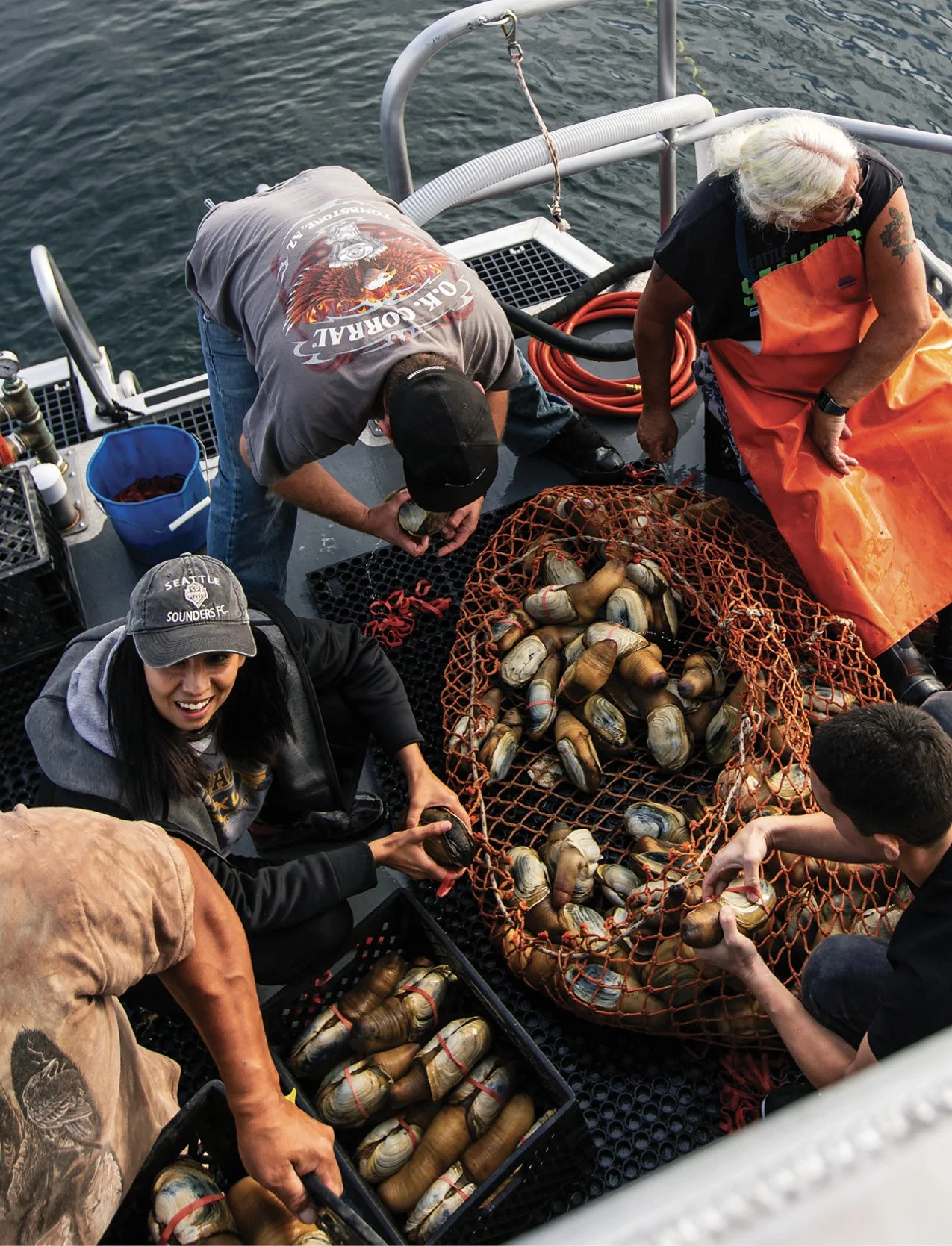
Suquamish Tribal diver Lydia Sigo and crew on F/V Carriere
Geoducks have long been part of the culture and diet of the Suquamish and other coastal tribes. The treaties signed in the 1850s promised the tribes half of the shellfish harvest, but later, Washington state regulations restricted their access to the treaty-protected fishing grounds. The 1974 Boldt Decision reaffirmed the tribes' rights and recognized their inherent sovereignty. The ruling addressed salmon and steelhead fisheries, and a 1994 decision extended the rights to shellfish.
The rulings mean that today, the Washington Department of Natural Resources (DNR) manages the geoduck fishery alongside 15 Puget Sound Treaty Indian Tribes, who are entitled to 50 percent of the sustainable, allowable catch. Together, the tribe and the state work to minimize the shoreline impact and protect the slow-growing wild geoduck stock from overharvesting. The state auctions its share to private businesses, which generates about $22 million in revenue annually, according to the DNR.
"For us to get to be out with our tribe on a boat and fishing together is an important part of our culture and important to perpetuate our identity as a tribe," says Sigo.
Suquamish Seafoods was founded in 1996 after the geoduck rights were affirmed by the courts. The geoduck, drawn in Salish art style, is the company's logo.
"It's a very large source of income for the tribe and tribal members and is what started this company," says Aaron Purser, the company's Health Compliance and Dive Services Manager. "It's still our main product and is the main thing that keeps this company going currently."
Purser doesn't consider it unusual to have women divers and says the major concern is keeping all the company's divers safe.
"Every time a diver gets in the water it's dangerous," says Purser, who is related to the tribe's women divers. "We take
every stop possible to keep them safe."
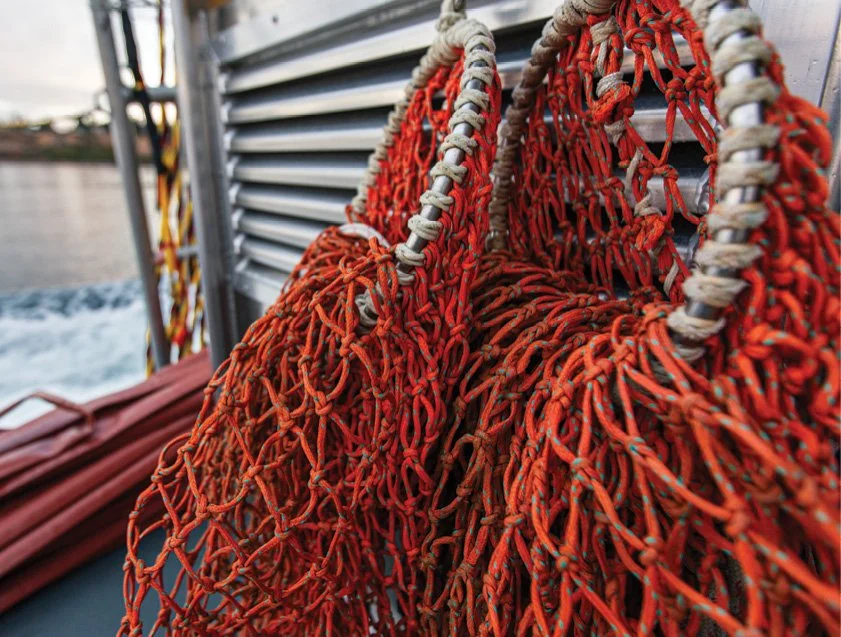
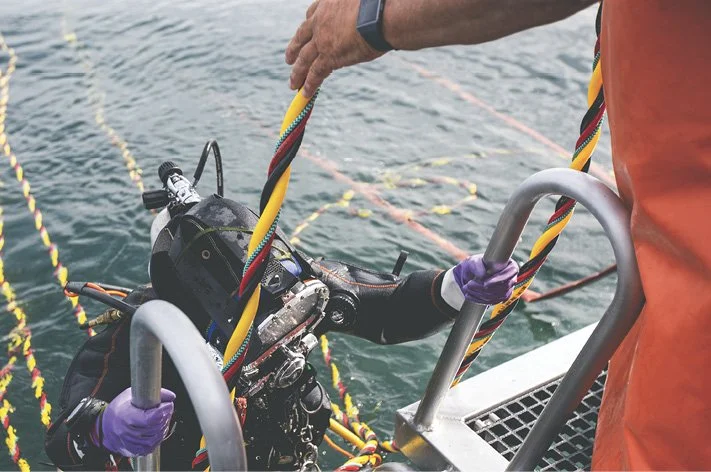
That includes regular equipment checks and always sending out at least two divers. The divers have an airline attaching them to the boat and carry a backup air tank, called a bailout, that is connected to their masks. Modern technology also keeps them in full communication with those onboard the craft.
"I feel pretty spoiled," says Hess. "I'm used to being connected to the boat and being able to talk to someone. I feel pretty safe down then."
Her sister, Heather Purser, says that level of support helped her get over her initial fears. She had put her name in the lottery although she did not like being underwater. She decided to go for it when, at age 25, her name was selected. "I really like to confront whatever I'm afraid of. I always told myself that you're going to be afraid, but no matter what, you'll be all right. I had a whole team."
Suquamish Seafoods also focuses on the health and safety of the geoduck and its environment. Once a week, a diver snatches three geoducks from the tract they're currently fishing in and sends them to a lab for testing. The results determine whether harvesting continues on that tract. The tribe also carefully monitors how much can be harvested from a tract before closing it to avoid overfishing. Some tracts may remain closed for 20 years or more before testing shows they're ready to be harvested again.
The divers are witnessing first hand how the underwater world is changing due to climate and other factors. "At first diving was incredible seeing all the fish, and there were a lot more of them. Now it's not as beautiful to me," says Heather Purser, 42, describing how she sees less eelgrass and finds starfish that are disintegrating.
But, she adds: "The geoducks are really hardy. Geoducks have persevered."
Once in the water, Purser says "the trick is trying to figure out where they are. Sometimes you're running the entire time and hardly finding anything and then some days you stay in one spot and it's great."
Washington tribes with geoduck fishing rights:
Jamestown S'Klallam
Lower Elwha Klallam
Lummi
Makah
Muckleshoot
Nisqually
Nooksack
Port Gamble S'Klallam
Puyallup
Skokomish
Squaxin Island
Suquamish
Swinomish
Tulalip
Upper Skagit
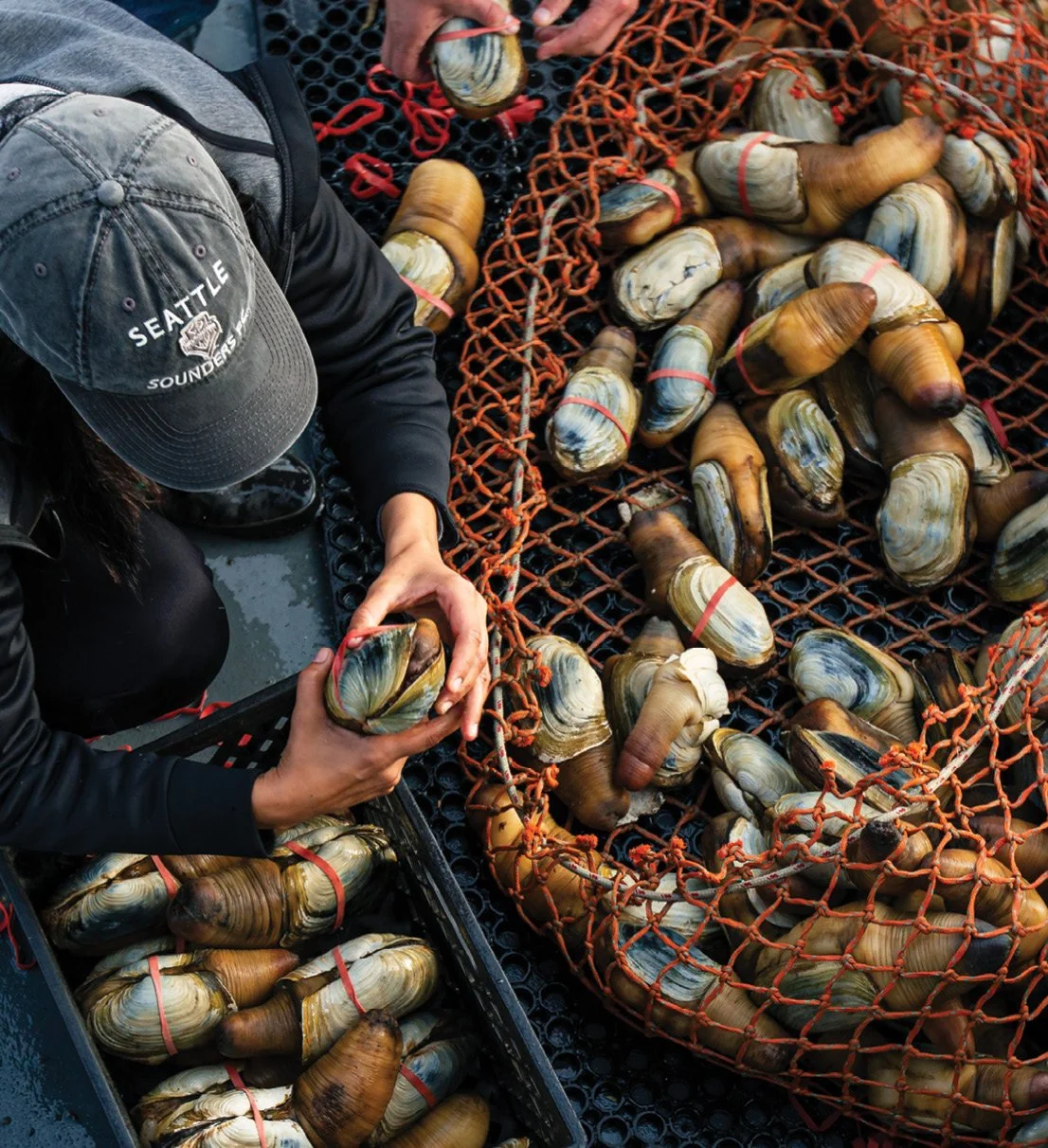
The divers, certified to 99 feet, go down to around 55 feet. Their equipment includes a high-pressure hose, or wand, called a "stinger." When they spot a geoduck, they grab one end with their left hand and with their right, they use the stinger to break the suction in the sand, freeing the bivalve so they can pry it out.
The geoducks don't always cooperate. "If you're not fast enough, they will sink out of your reach," says Hess. "I'll be down there up to my armpit trying to grab it, and they will push farther into the sand. But you don't want to spend too much time on one geoduck. If it sinks down pretty low, then it wins and you move on to the next."
The divers have a bag for holding the geoducks. When it's full, they send it up to the boat and an empty one is lowered to them. They keep filling the bags until they meet their day's quota, an amount based on the orders placed with Suquamish Seafoods—orders that have been declining due to tariffs with China. While the divers don't know the exact weight of each geoduck they catch, Hess says, "There are absolutely huge geoducks that are as long as my arm. It's amazing how big they are." (see sidebar).
All the divers have stories of getting caught on lines and
other moments when the dangers of their job became real. "It's rarely very easy," says Sigo. "You have an air line and a water line and they can get fouled on the anchor chain or boulders or
other divers' airlines."
And then there are the crabs. Hess says most underwater life stays out of the divers' way, but not crabs. "I've found crabs to be the most aggressive creature down there," she says. "Crabs will come charging right at you sometimes. The only thing that startled me once and made me yell down there was when a crab attached itself to my hand and was hard to get off."
Depending on the orders Suquamish Seafoods needs to
fill, the divers go out about once a week, and the season
usually ends before the coldest days of winter. Hess says they can continue diving as long as they are able—one of the company's divers is 73.
The divers are allowed to take six pounds of geoduck home from those with broken shells. They may be cooked in a chowder or as fritters and taste like clam but are chewier with a
rubbery texture. Some might be dried and given to little kids who like to chew on them, and some are used in meals distributed to tribal elders.
A few geoducks are sold to the public at the Suquamish Seafoods store next to the Masi shop gas station on Highway 305, where they fetch about $12 a pound. Most, however, are shipped to China, generating significant revenue for the Suquamish.
"I like that we take care of our people with the money and that most of what I harvest is going right back to my people," says Heather Purser. "There was a period of time where our people weren't allowed to go out and fish. Being able to do it and practice our treaty rights means a lot to me. I'm proud that we're still out there. I'm honored and grateful to be doing this and feel connected to my culture and to my people."
What the duck!
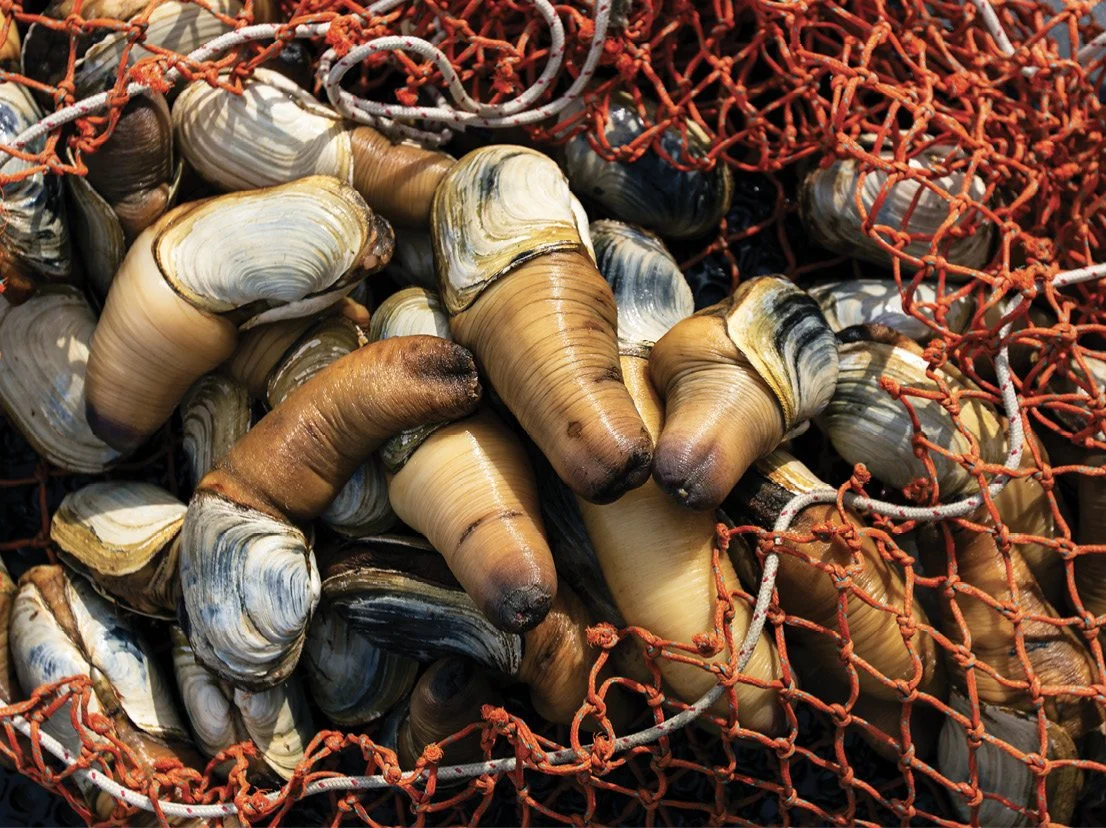
Geoducks are fascinating, and not just for their distinctive (and suggestive) appearance. Here are some fun facts about them:- The geoduck is native to the Pacific Northwest and is the
world's largest burrowing clam.
- Geoducks can weigh more than 2 lb.; the largest verified
by Washington Department of Fish & Wildlife biologists
weighed 8.16 lb.
- They can live as long as 168 years.
- Geoduck clams bury themselves 2 to 3 ft. deep in mud,
sand or gravel.
- Their bodies are too large to fit entirely inside their own shells
and their elongated siphons (or neck) can extend up to 3 ft.
- The name geoduck (pronounced GOO-ee-duk) comes from
Lushootseed word gʷídəq, meaning "dig deep."
- "Speedy the Geoduck" is Evergreen College's mascot.